I first published this post in February 2024, when the Modern Snowflake Stack was a constellation of independent vendors, each owning one layer around Snowflake. Two years later, half of them have merged, been acquired, or repositioned around AI agents. Time for a refresh.
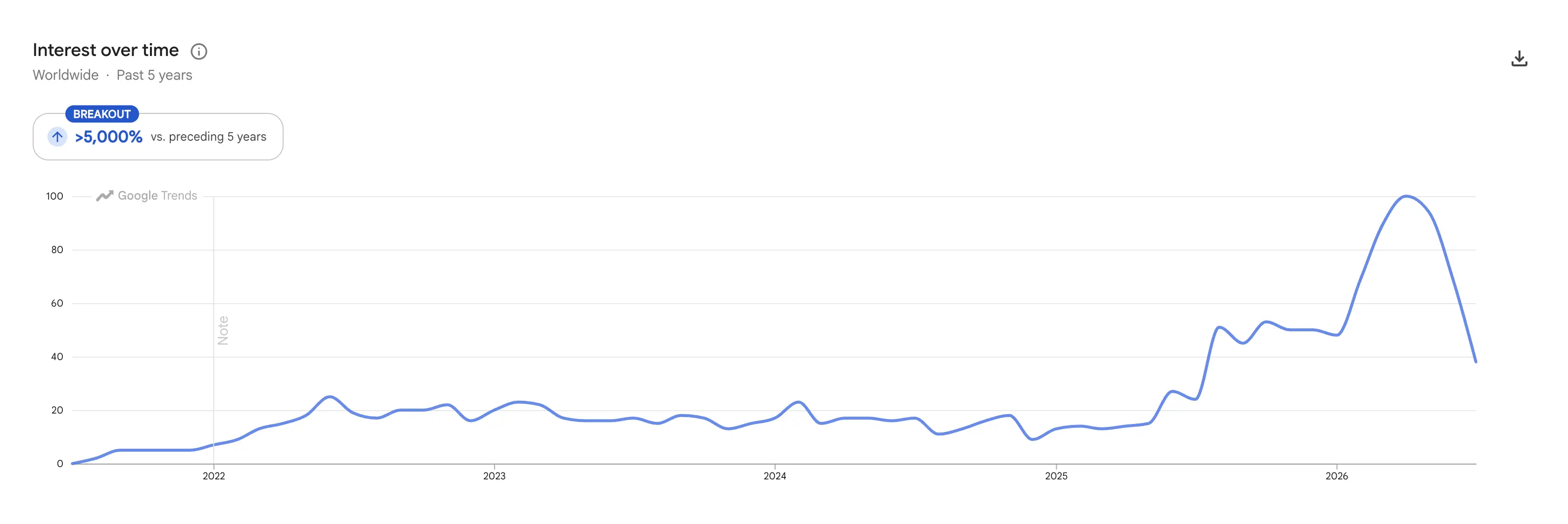
If you want the refresh in one chart, this is it: Google Trends for semantic layer, flat for four years, then a >5,000% breakout once the agents arrived. The layer that did not exist in the 2024 version is now the hottest thing in the stack. We will get there.
Snowflake played the pivotal role in the Modern Data Stack era, so this post walks the tools built around it, layer by layer, and notes what changed since 2024.
Data Ingestion - Fivetran
Fivetran automates extracting and loading data into the warehouse through a large library of pre-built connectors. The Salesforce to Snowflake connector remains its flagship.
It is also where the biggest story of this refresh begins. In May 2025 Fivetran acquired Census, the reverse-ETL leader. In October 2025 it announced a merger with dbt Labs, which closed on June 1, 2026 at nearly $600M combined annual revenue. Three boxes from my 2024 diagram now share one cap table.
Meanwhile Snowflake built its own ingestion: Openflow, launched at Summit 2025 on top of Apache NiFi (via the Datavolo acquisition). Native, event-driven, hundreds of connectors. Fivetran still wins on breadth and polish, but the moat is being circled.
Data Transformation - dbt
dbt (data build tool) turns warehouse transformations into code: SQL models that are version-controlled, tested, and deployed. It remains the de facto standard for the "T" in ELT, and Snowflake remains its favorite execution engine.
Two changes. dbt Labs rewrote the engine in Rust (Fusion, built from the SDF acquisition) and open sourced its runtime as dbt Core v2.0 after the merger. And Snowflake made dbt native: dbt Projects on Snowflake went GA in January 2026, running dbt entirely inside Snowsight. No dbt Cloud subscription, no self-hosted runner, no external orchestrator.
When your ingestion vendor owns your transformation tool, and your warehouse runs it natively, the boundary lines in any stack diagram start to look negotiable.
Semantic Layer - Suddenly, Everyone
This layer did not exist in the 2024 version, and that is the point. The semantic layer is an old idea (BusinessObjects universes, OLAP cubes, LookML) that kept failing to become its own layer, because dashboards tolerate ambiguity: a human eyeballing a chart absorbs definitional drift. AI agents do not. Text-to-SQL against raw schemas produces plausible SQL; against a curated semantic model it produces governed SQL that a human approved.
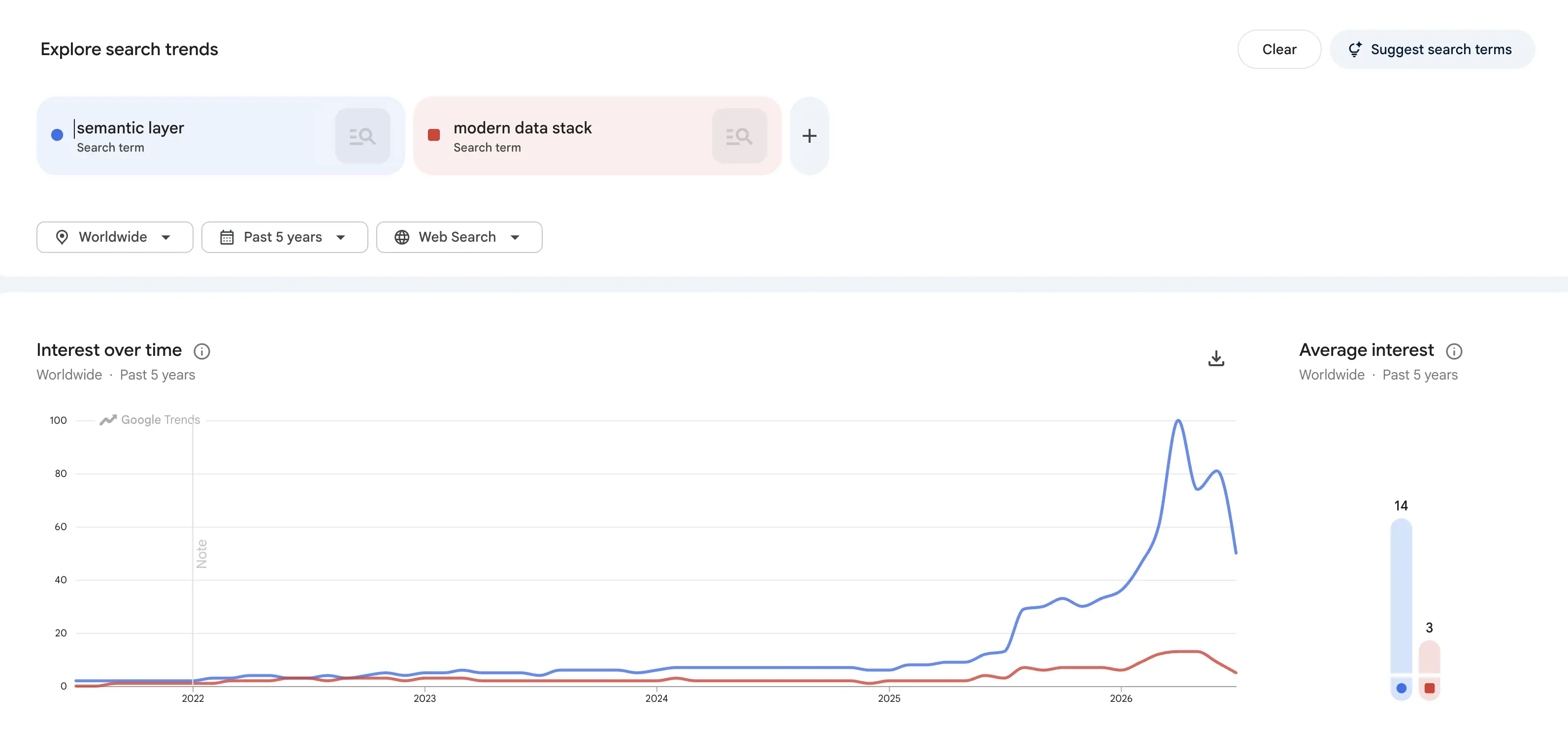
The momentum is measurable: on Google Trends, the term that named the whole era is now a flat line under the layer it never bothered to include, average interest 14 versus 3 over five years.
So everyone built one. Snowflake shipped semantic views that Cortex Analyst, CoWork, and CoCo all read from. Databricks answered with Unity Catalog metric views, GA in April 2026 and open sourced into Apache Spark. dbt has owned MetricFlow since 2023, so the merged Fivetran + dbt owns one too. The independents (Cube, AtScale, Honeydew) repositioned as the neutral option, queried by agents over MCP.
The momentum peaked in an unlikely place: a standards body. Open Semantic Interchange launched in September 2025, led by Snowflake and Salesforce, and published a vendor-neutral YAML spec in January 2026 with 40+ partners. When Snowflake, Databricks, and Salesforce co-sign a spec, you know where the choke point is: whoever owns the semantic layer owns the control plane for AI analytics. OSI makes definitions portable. Where they live is still the fight.
Data Security - Immuta
Immuta manages access control, masking, and privacy compliance at scale, for organizations handling sensitive data under GDPR, CCPA, HIPAA and friends.
Immuta is one of the survivors: still independent, still valued around $1B. But Snowflake's built-in governance grew into Horizon Catalog, covering the baseline access control, masking, and discovery that used to justify a third-party purchase. Immuta responded by climbing up the stack: at Summit 2026 it launched agentic data access, zero-standing-privilege access for AI agents with a dual-identity audit trail. The pattern repeats across this list: when Snowflake absorbs your core feature, you go govern the agents instead.
Data Catalog - Atlan
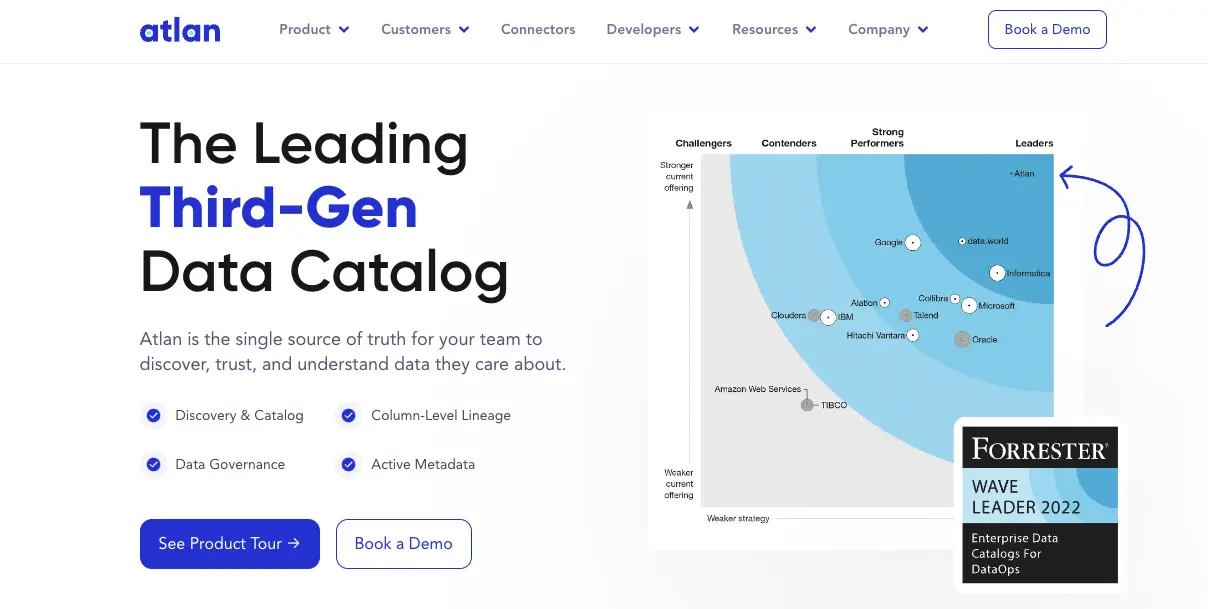
Atlan is a data catalog and collaborative workspace for discovery, governance, and metadata. It had a good two years: a Leader in both the Gartner Magic Quadrant for Data & Analytics Governance (2026) and the Forrester Wave for Data Governance. Its Snowflake story evolved from "built on top of Snowflake's features" to "the cross-system layer above Horizon": Horizon governs what lives inside Snowflake, Atlan stitches lineage and policy across everything else. A sensible division of labor, as long as Snowflake stays on its side of the line.
Data Monitoring - Bigeye
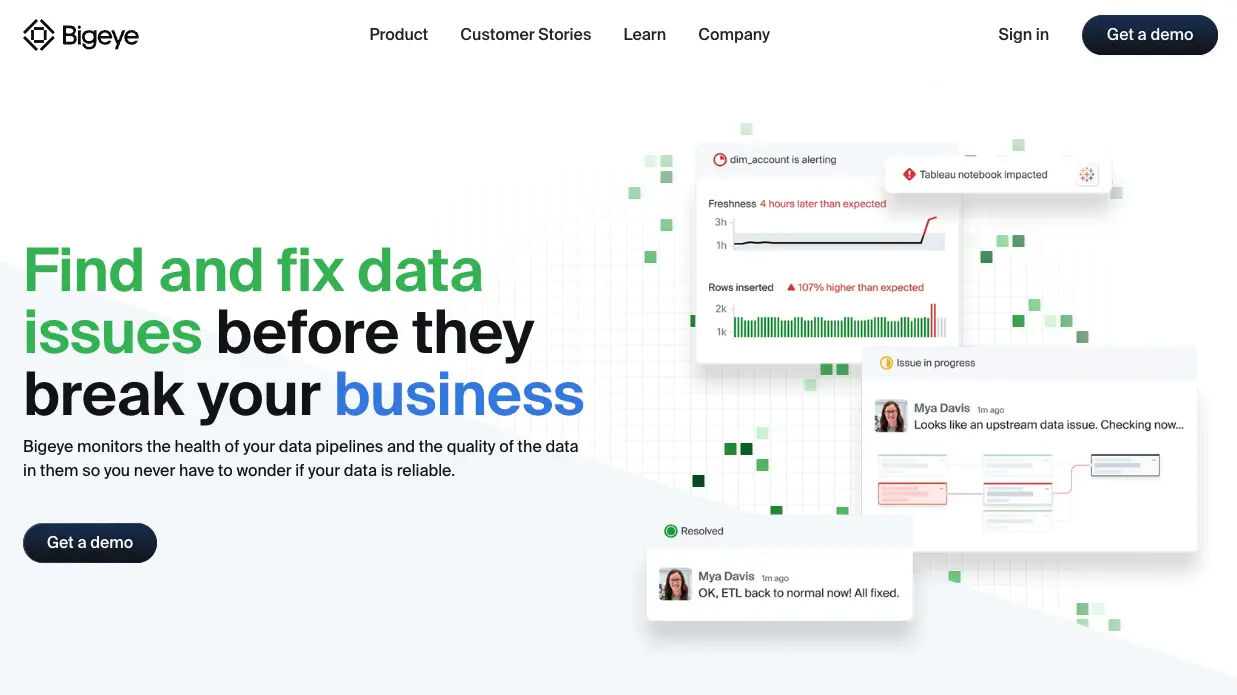
Bigeye started as a data observability platform: data quality monitoring, anomaly detection, lineage. That is now the smaller half of the company. Bigeye rebranded around an "AI Trust Platform" and in June 2026 launched Agent Trust Hub, mapping AI agent activity to data quality, classification, lineage, and cost signals. Same telemetry, new customer: the thing consuming your data is no longer just a dashboard.
Snowflake made its own observability move in January 2026: acquiring Observe for roughly $1B, the largest acquisition in its history. To be fair, Observe is infrastructure telemetry (logs, traces, an AI SRE) rather than data quality, so Bigeye is not directly displaced. But Snowflake clearly wants the observability workload too.
Data Activation - Census / Hightouch
In 2024 I wrote that Census and Hightouch were neck-to-neck in reverse-ETL and that it was better to leave the judgement to the audience. The market delivered the judgement for us. Census sold to Fivetran in May 2025 and now lives on as Fivetran's activation layer. Hightouch stayed independent, raised at a $1.2B valuation, and repositioned as a Composable CDP with AI Decisioning: instead of syncing segments that humans define, an AI decides which message goes to which customer.
Two companies that once shipped mirror-image comparison pages ended up in different businesses entirely. Reverse-ETL turned out to be a feature, not a company. Census accepted that; Hightouch out-ran it.
The 2024 version gave Segment its own CDP section. Its update is corporate rather than technical: activist investors pushed Twilio to divest it; after an operational review Twilio decided to keep it. Meanwhile the composable-CDP camp led by Hightouch keeps arguing your warehouse should be the CDP, and that argument gets easier every year. So Segment loses the standalone section, and this stack gets a little more Snowflake-shaped.
CI/CD - Bytebase
After all, Snowflake is a database system, and the pain point for any database is schema migration. Everything above is DataOps; schema migration is CI/CD. Snowflake open sourced schemachange, a python CLI in the spirit of flyway, and it is still maintained. The bigger native move is DCM Projects (public preview since March 2026): declare the desired state of your Snowflake objects, and Snowflake plans and applies the diff, terraform-style, without terraform state drift.
Bytebase approaches the same problem from the review side. It provides a GUI collaborative workspace with review workflow and version control for Snowflake schema migrations and ad-hoc changes, like what GitHub does for code management.
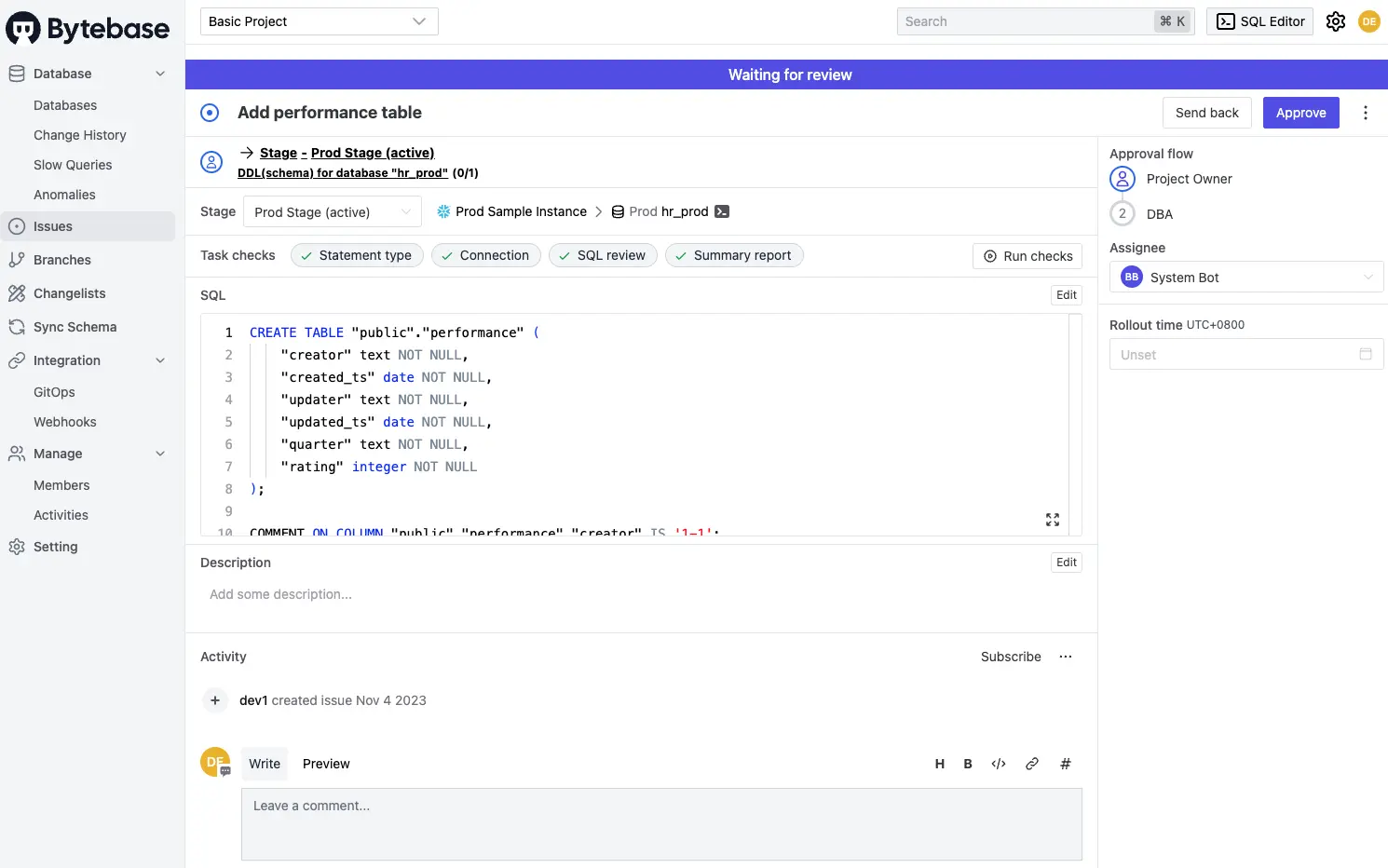
It also provides native GitOps integration with all mainstream VCSs to manage the change scripts in the repository.
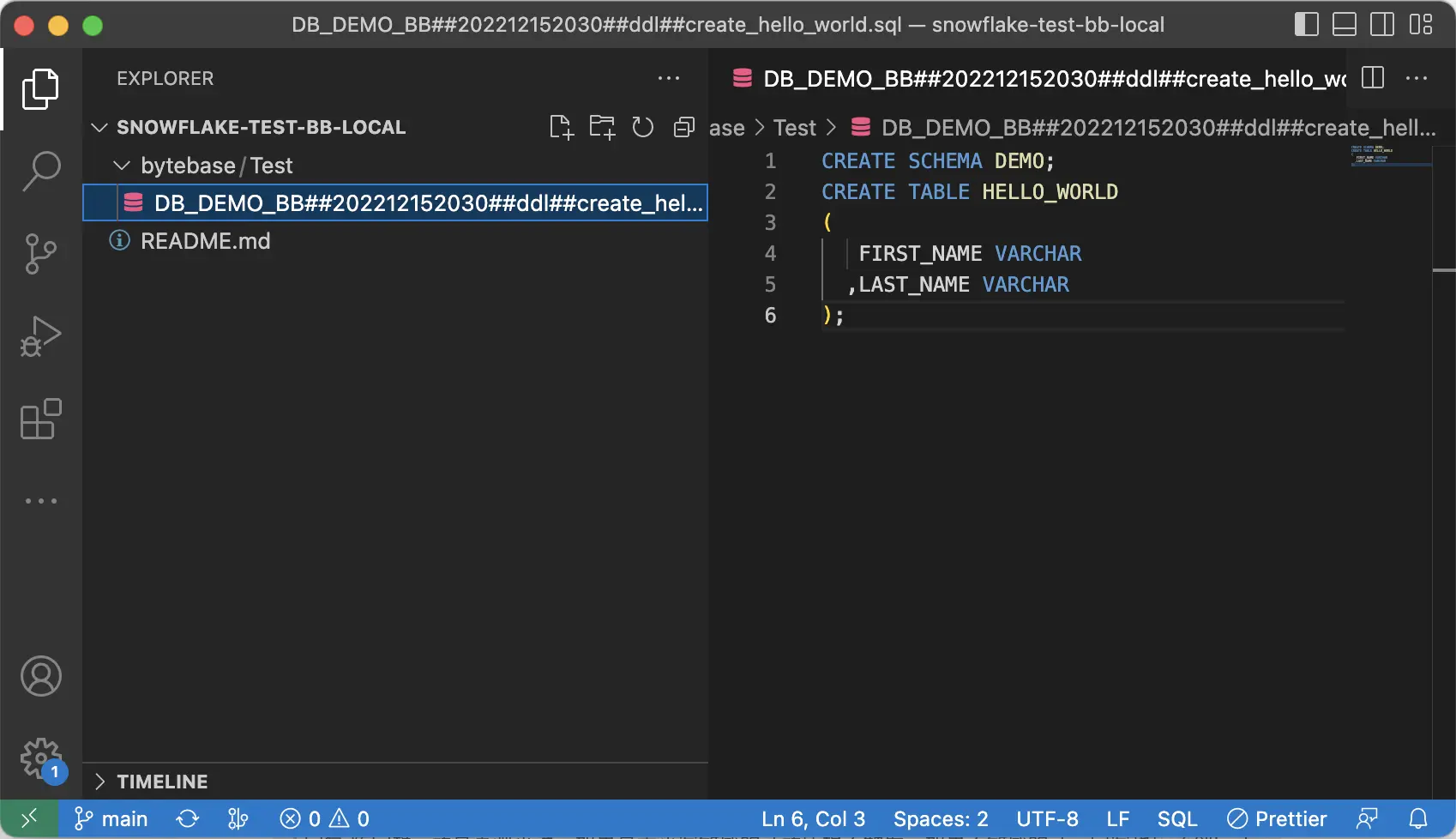
The practical difference: schemachange and DCM Projects manage Snowflake. Bytebase manages Snowflake next to everything else, because Snowflake is rarely your only database. The same review workflow, approval policy, and audit trail apply to the PostgreSQL and MySQL fleet feeding the warehouse. If your change process ends at the warehouse boundary, you have two change processes.
Data Analytics - Hex
Hex is an AI analytics platform built around notebooks: SQL, Python, and no-code in one workspace, published as interactive data apps and dashboards. Since 2024 it went all-in on agents: a Notebook Agent that writes queries and builds charts, Threads reachable from Slack, semantic models to keep the answers governed.
Hex was not in the 2024 version either; it earns the slot because of who keeps funding it. Snowflake Ventures invested, increased its stake, then joined the $70M Series C in May 2025. It also inherited much of Mode's audience after ThoughtSpot acquired Mode. Not Snowflake-exclusive (it speaks BigQuery, Databricks, and Redshift too), but the closest thing to an ecosystem-blessed analytics front end for Snowflake.
The BI prediction, graded
In the 2024 version, this section was called "What are we missing?" and noted the elephant in the room: there was no outstanding BI tool built specifically for Snowflake. I wrote: "Maybe the industry is just waiting for Snowflake to announce its own BI solution, not a far sight from Snowsight anyway."
Grading honestly: half right. Snowflake did ship its own answer: Cortex Analyst (natural language to SQL against a governed semantic layer), then Snowflake Intelligence, renamed CoWork at Summit 2026: a conversational agent that answers questions, publishes live RBAC-scoped dashboards, and generates deliverables on Snowflake data. But calling it a BI solution is a stretch. No drag-and-drop authoring, no pixel-perfect layout, Snowflake-only. Teams still keep Tableau or Looker for the hand-crafted dashboards, so the elephant is still in the room. What Snowflake shipped is a different bet: you ask an agent instead of opening a dashboard. Whether that bet retires the BI license is a prediction for the next refresh.
Summary
The 2024 summary opened with a chart of Modern Data Stack picking up; this refresh opened with semantic layer breaking out. The torch has passed. Jim Barksdale said there are only two ways to make money in business: bundling and unbundling. The Modern Data Stack era was the great unbundling: one vendor per layer, composed via the warehouse. Now comes the re-bundling. Fivetran, dbt, and Census merged into one company. Snowflake absorbed ingestion (Datavolo becoming Openflow), transformation (native dbt Projects), observability (Observe), BI (CoWork), and even OLTP: it bought Crunchy Data to ship Snowflake Postgres weeks after Databricks paid ~$1B for Neon. When both warehouse giants buy a Postgres company in the same season, that tells you where the puck is heading (and Databricks still disagrees with Snowflake on everything else).
The independents that remain (Atlan, Immuta, Bigeye, Hightouch) all made the same move: reposition one level up, from governing data to governing the AI agents that consume it. The stack consolidated; the pendulum will swing back. See you in 2028!