Zero trust has become a crowded phrase. Depending on who is selling, it can mean identity, device posture, network segmentation, ZTNA, PAM, or a slightly shinier VPN.
Those controls matter. But they mostly determine whether a user, device, or agent can reach the resource.
The harder question starts after the connection succeeds:
Can this actor run this SQL in this environment, at this time? Against which tables and rows, with which columns unmasked—and may they export the result?
That is where zero trust often gets thin. A developer passes SSO and reads raw production PII. A support engineer gets a temporary tunnel and exports too many rows. An AI agent inherits a user's permissions and runs generated SQL. An engineer-authored migration ships with no independent policy check.
The login was verified. The connection was allowed. What happens next still needs a decision.
That next decision is SQL control.
Zero trust moved the perimeter
NIST SP 800-207 shifts the security focus from static, network-based perimeters toward users, assets, resources, and workflows. For database workflows, the protected resource is not the VPN or private subnet. It is the data and schema.
The NSA's data-pillar guidance makes this explicit by covering data cataloging, governance, tags, monitoring, encryption, loss prevention, and access control.
For databases, "never trust, always verify" means not treating a standing privilege, authenticated session, engineer-authored migration, or agent credential as proof that the next operation is safe. Reads, writes, and schema changes should be evaluated against policy and recorded with the actor, decision, and outcome.
The four controls behind SQL control
SQL control is not one feature. It is the combination of identity, authorization, policy enforcement, and audit.
| Control | Database question | Failure when missing |
|---|---|---|
| Identity | Who is the real actor: human, service, or AI agent? | Shared credentials erase attribution. |
| Authorization | What can this actor access, for how long, and under what scope? | Standing privileges outlive the business need. |
| Policy enforcement | Is this SQL, result, or change allowed by rule? | Review, masking, and safety depend on memory. |
| Audit | Can we prove what happened afterward? | Incidents become archaeology. |
Reads and writes need different controls
Reads leak data. The read path needs access control, masking, row and column constraints, export limits, query history, and audit tied to the real actor. The question is not just whether someone has SELECT. It is whether this workflow should expose this data in this form. A full SSN, a masked SSN, and the last four digits are three different answers to the same query.
Writes change reality. An ad hoc UPDATE can mutate billing records immediately. A schema migration can lock a table or break a downstream application. Data changes may need affected-row checks and transaction safeguards; schema changes may need SQL review, staged rollout, deployment history, and a rollback or roll-forward plan.
Database governance therefore has to sit in the workflow, not only in the database privilege table. Native grants, row-level security, and separate application roles remain necessary. But policy decisions often need context the database engine does not have: approval state, ticket context, data classification, temporary access, or deployment policy.
AI agents make the old gaps obvious
A shared production credential is already an anti-zero-trust pattern; an agent with the same credential exercises it at machine speed. The risk compounds when the agent runs unmasked ad hoc SQL or bypasses migration review. An agent-authored migration applied through that path makes the fragility obvious.
The uncomfortable part is attribution. If an agent uses a generic database user, who acted? The agent, the user who prompted it, the developer who deployed it, or the platform team that issued the credential?
The ideal audit trail records both the agent and the person or service on whose behalf it acts. At a minimum, the agent should inherit scoped authorization, follow the same masking and change policies as a human, and leave an audit trail tied to the authenticated account and client context.
Maturity comes from adding context
Database zero trust matures by adding layers, not replacing them. Identity providers establish the user, ZTNA controls the network path, PAM manages privileged credentials, and native roles provide baseline permissions. SQL control adds database context for reads, results, data changes, and schema changes.
A team can progress from named identities to time-bounded production access, classified and masked data, separate export and unmask permissions, and operation-specific policies. Routine reads can be allowed and logged automatically; sensitive reads can be masked; large exports can require approval; and production migrations can receive stronger checks than development changes.
The practical work is to inventory every database route, remove shared and standing access where possible, define policies by operation, and let an engineer request short-lived access to run a specific SELECT or EXPLAIN against production.
Where Bytebase fits
Bytebase implements SQL control in the workflow where people and agents request access, run SQL, review changes, apply migrations, and create an audit trail:
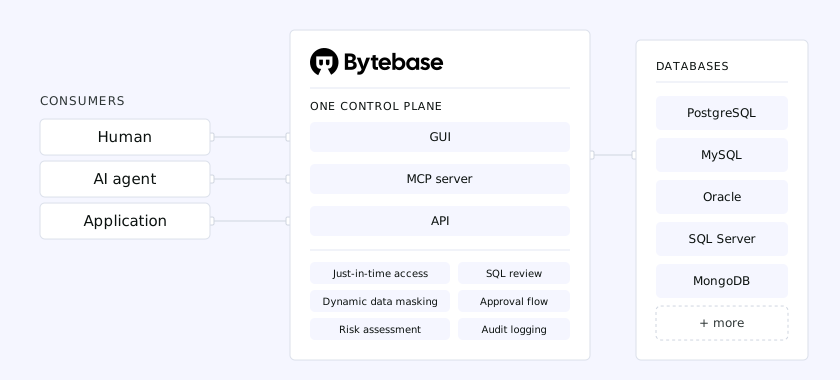 Bytebase is one control plane between consumers (human, AI agent, application) and databases, enforcing just-in-time access, dynamic data masking, SQL review, risk assessment, approval flow, and audit logging
- Database permissions associate workspace identities and roles with database access.
- Just-in-time access provides time-bounded roles or access to a specific read-only SQL statement, with separate requests for unmasking and export.
- Dynamic data masking applies policy to sensitive query results.
- SQL review and approval workflows govern schema and data changes before they reach production.
- Audit logs record database operations and workspace changes with actor and resource context.
- MCP access lets an AI assistant use the connected user's Bytebase permissions, applies masking and result limits, and records actions under that user's account.
The enforcement boundary matters. Bytebase governs operations routed through Bytebase. Direct credentials, application connections, and other paths must be removed, restricted, or controlled independently. No workflow product can evaluate SQL that bypasses it.
Govern the SQL, not just the login
A user can pass SSO and still run the wrong SQL. An engineer-authored migration can still need review. An AI agent can generate correct SQL and expose the wrong data.
Access control verifies who gets in. SQL control governs what happens next. Zero trust for databases requires both.