Yes, this is a pedantic post. Data governance and database governance differ by four letters, and people mix them up all the time. AI does too. If you ask an AI what database governance is, it will probably describe data governance: catalogs, lineage, and stewardship. People also keep asking me whether Bytebase competes with Collibra. It does not. The two are different disciplines. Different teams own them, and different tools solve them.
The confusion is understandable, because both do similar things: they classify data, control access, and audit. The difference is where they apply and who owns them. Data governance applies to the data warehouse and belongs to the data team. Database governance applies to the production database and belongs to the engineering team.
Follow the flow
Data moves through a company in one direction, like a stream. The two disciplines sit at different points along it.
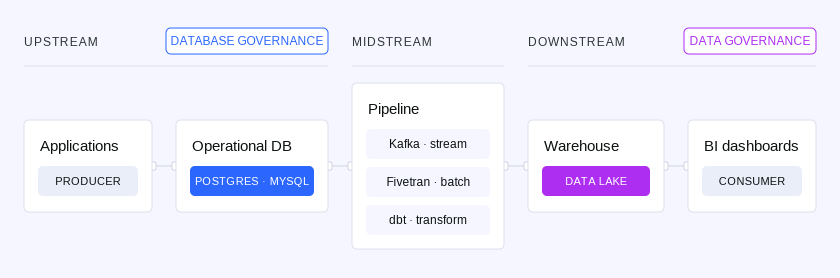 Database governance applies to the production database, data governance applies to the warehouse, and the pipeline runs between them.
Upstream is the production database. When a customer places an order, the application writes it to Postgres or MySQL, not to the warehouse. All the data the business will later analyze starts here. Database governance works at this point. It means that changes are reviewed, access is controlled, and activity is audited.
Midstream is the pipeline. Kafka streams the data, Fivetran copies it in batches, and dbt reshapes it. A data engineering team owns this part. Their job is to move the data. They own neither the production database nor the warehouse.
Downstream is the warehouse and the data lake. Data governance works here. It covers the catalog, lineage, and quality checks, and it has its own access policies and audit. BI dashboards, analysts, and ML models all read from the warehouse.
Each of the three parts has a different owner. Problems also travel downstream. A careless migration on the production database shows up in every dashboard that depends on it. Lineage can tell you where bad data came from. Only database governance can stop it before it leaves the production database.
Databricks announced Lakebase, which puts Postgres on its data lake platform. This can look like the line between the two is blurring. It shows the opposite. The two systems are so different that Databricks could not build an operational database on its own platform. It paid about $1 billion to acquire Neon instead. Snowflake first tried to build one in-house with Unistore, and then still decided to acquire Crunchy Data for Postgres.
The pager test
When governance fails, who gets paged? Here is one incident, followed from the production database to the dashboard.
A developer renames orders.total_amount to amount. The app team reviews the migration, updates the application in the same deploy, and ships it. The production database is healthy. In the pipeline, Fivetran treats amount as a new column, and total_amount stops updating. In the warehouse, the dbt revenue model still reads total_amount, which is now null for every new row. Two days later the CFO opens the dashboard, and revenue appears to have collapsed.
The analyst is contacted first, because the dashboard looks wrong. The investigation goes backward: first the model, then the sync, then the rename. The postmortem is uncomfortable, because nobody was negligent. The app team followed its process. Few engineering teams have a process for notifying everyone who reads a table downstream. Fivetran copied what it saw. The data team could have put a staging layer in front of the model, but teams rarely budget for a rename that has not happened yet. The incident appeared in the warehouse, and the cause was in the production database.
The incident happened in the gaps between teams, so each part needs its own control. Upstream, a change workflow makes schema changes visible to people outside the team that ships them. Midstream, the sync detects schema drift. Downstream, a staging layer separates models from raw tables. The first control is database governance, and the last is data governance. The dashboard is only safe when all three are in place.
Here are the two disciplines side by side:
| Data governance | Database governance | |
|---|---|---|
| Governs | The data warehouse and data lake (downstream) | The production database (upstream) |
| Asks | What does this data mean, and can I trust it? | Who can change or query this database, and does everyone affected know? |
| Owner | CDO, data platform team | VP Eng, DBA, platform engineering |
| Budget line | "Data strategy" | "Developer platform" |
| Deliverables | Catalog, business glossary, lineage graphs, plus access policies, masking, and audit on the warehouse | Migration review pipeline, just-in-time access, masking, and audit on the production database |
| Success metric | The board gets one number for "active customers" | Production stays up; no surprise schema changes downstream |
| Tools | Collibra, Atlan, Alation, Purview, DataZone, Dataplex, Unity Catalog, Horizon | Bytebase |
The two columns look alike on purpose. Governance involves the same activities everywhere, and compliance budgets pay for both. The row that differs is the tools. Data governance has three well-funded independent vendors, a catalog from every major cloud provider, and the data platforms' own products. Database governance has very few tools.
There is a reason for the difference. Data governance has an executive buyer. A CDO has a budget and a mandate, so vendors compete for it. The buyer for database governance is engineering, and engineering teams rarely shop for a product. They make do with a migration CLI, a bastion host, and a shared admin credential that nobody talks about.
That is understandable, but it leaves the job half done, because everything in the warehouse is a copy. The numbers in the warehouse come from the production database, and that is where the ungoverned changes happen: a schema change nobody announced, or a manual fix that skipped review. If you govern the warehouse but not the production database, the catalog only records the damage after it arrives.
The overlap is real
A stricter pedant could point out that a warehouse is also a database, one tuned for analytics. That is true. It is why I draw the line by where the data sits and who owns it, not by the technology.
The features overlap as well. Production databases are adding governance features that warehouses already have. SQL Server has ADD SENSITIVITY CLASSIFICATION as a DDL statement, Oracle has Data Safe, and Bytebase can use a classification taxonomy to decide which columns to mask.
This overlap does not mean one program can cover both. Most production workloads run on plain Postgres, MySQL, SQL Server, and Oracle, and have nothing to do with a warehouse. The riskiest operations, such as a schema migration on a busy table or a manual UPDATE to a billing record, never go through a data catalog.
So when someone says "governance," ask which one they mean. If the conversation is about what the data means, where it came from, and whether the numbers can be trusted, they need a data catalog. If it is about who can change or query the production database, and how to prove it afterward, that is database governance. You need both. The difference is the base.
That difference now decides where AI agents are allowed to work. Most enterprises let agents query the warehouse, because the access controls are already there, and keep them out of the production database. I wrote about that in Agents Can Read the Warehouse. They Still Can't Touch Production.
References
- Lakebase, Databricks
- Databricks and Neon, Databricks Blog, 2025
- Delivering the Most Enterprise-Ready Postgres, Built for Snowflake, Snowflake Blog, 2025
- ADD SENSITIVITY CLASSIFICATION (Transact-SQL), Microsoft Learn
- Oracle Data Safe, Oracle
 Ask ChatGPT