This post is maintained by Bytebase, an open-source database governance platform. We update the post periodically.
Search for database governance tools and most of what you'll find are data governance platforms. The two terms are four letters apart and constantly conflated, but they are different disciplines. Data governance operates downstream: it catalogs, traces, and classifies data after it lands in the warehouse or lake. Database governance operates upstream: it controls how the production databases feeding that warehouse are changed and accessed. Different stage, different owner, different tools.
This list keeps the distinction explicit but covers both sides, because the story is incomplete without either. Four platforms — OpenMetadata, DataHub, Apache Gravitino, and Unity Catalog — handle data governance: the first two for discovery and stewardship, the newer two at the infrastructure layer, where open source is moving while stewardship stays commercial (Collibra, Atlan, Alation). The fifth, Bytebase, handles database governance. Every number in the warehouse is born in a production database; govern the copy without the source, and the catalog documents damage instead of preventing it.
OpenMetadata
OpenMetadata is an open-source platform for data discovery, observability, and governance built around a central metadata repository.
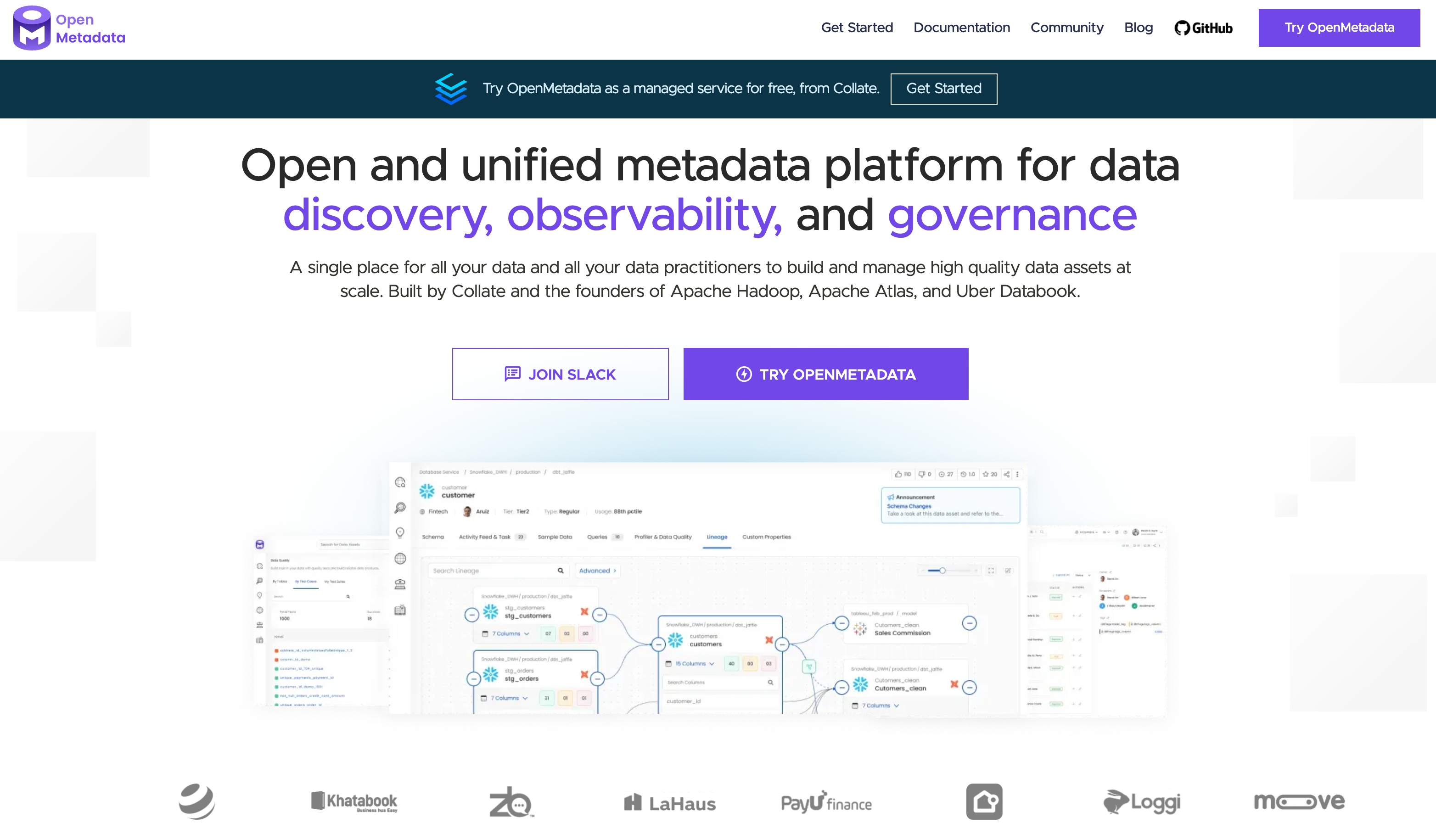
OpenMetadata covers the stewardship workflow in one package: search, column-level lineage, automated quality checks, no-code profiling, and classification. Recent releases added data contracts — machine-readable schema and quality guarantees enforced automatically. Its connector framework ingests metadata from databases, dashboards, messaging systems, and pipelines.
Together with DataHub, it leads the open-source catalog space in community size and release cadence. Pick it when you want a single, API-first platform that runs from discovery through governance without assembling parts.
DataHub
DataHub is an open-source metadata platform built at LinkedIn, organized around a real-time metadata graph.
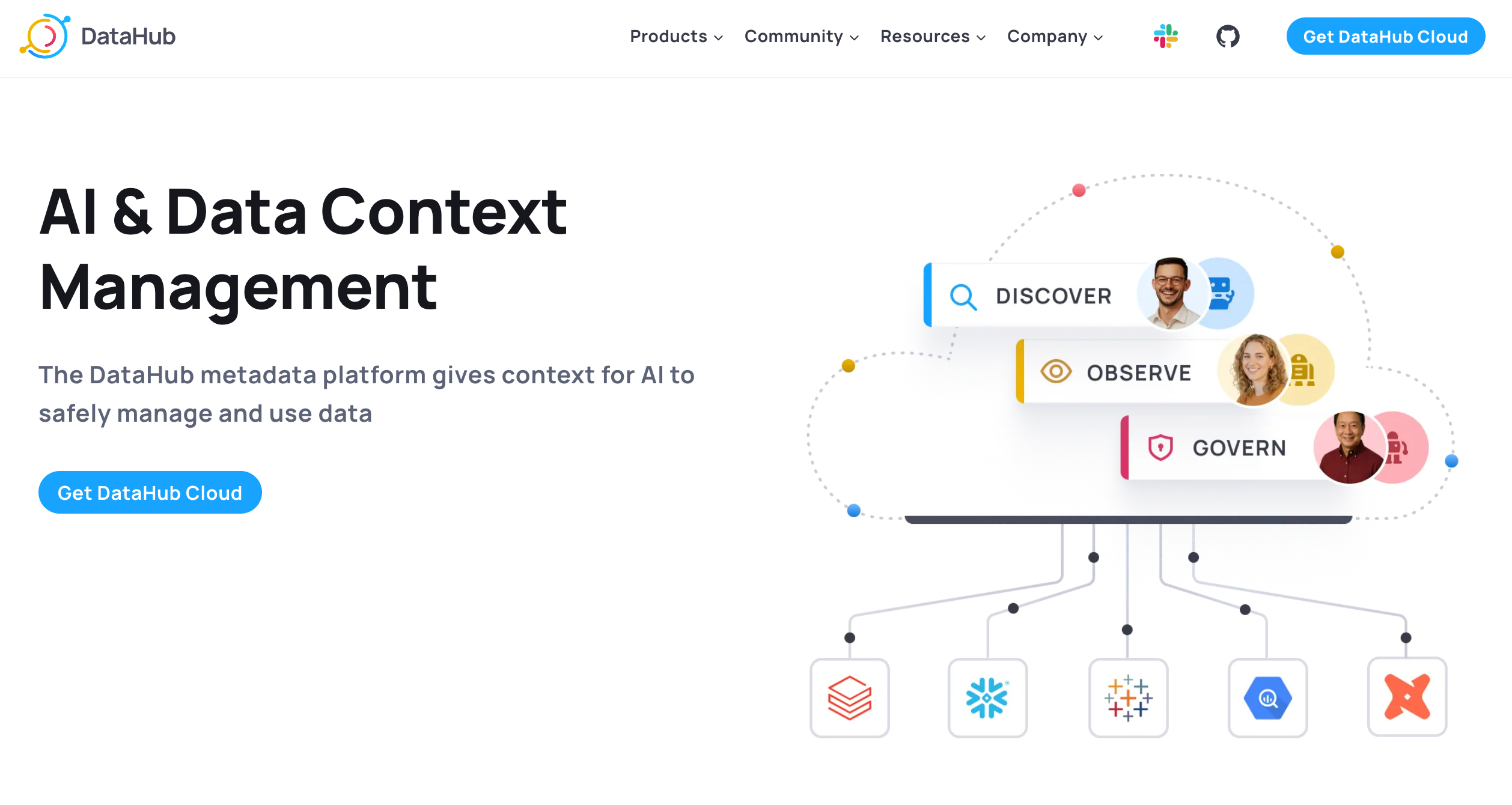
DataHub ingests metadata through streaming (Kafka) as well as batch, so the graph stays current instead of snapshot-stale. The graph connects datasets, pipelines, dashboards, and ML assets with end-to-end lineage, and a GraphQL API plus a customizable metadata model make it the more programmable of the two leading catalogs.
It carries the largest community in the space, and deployment scales from a single Docker instance to Kubernetes. A managed cloud tier exists for teams that don't want to operate the microservices themselves.
Apache Gravitino
Apache Gravitino is an open-source metadata lake that federates metadata across data warehouses, lakehouses, streaming platforms, and AI systems under a single API.
 Apache Gravitino
Gravitino graduated to an Apache Top-Level Project in June 2025 and is the fastest-moving new entrant in the category. Rather than crawling metadata into a separate repository, it fronts the existing systems — Apache Iceberg, Hive, Kafka, MySQL, PostgreSQL, and file storage — and exposes them through one consistent REST interface, so policies apply at the point of access instead of on a copy.
Recent releases pushed it from unified catalog toward an active governance control plane: OpenLineage-compliant lineage, role-based access control that spans catalogs, a policy and jobs system for metadata-driven actions, and an MCP server that lets AI agents query metadata directly. If your metadata is scattered across heterogeneous systems, evaluate Gravitino first.
Unity Catalog
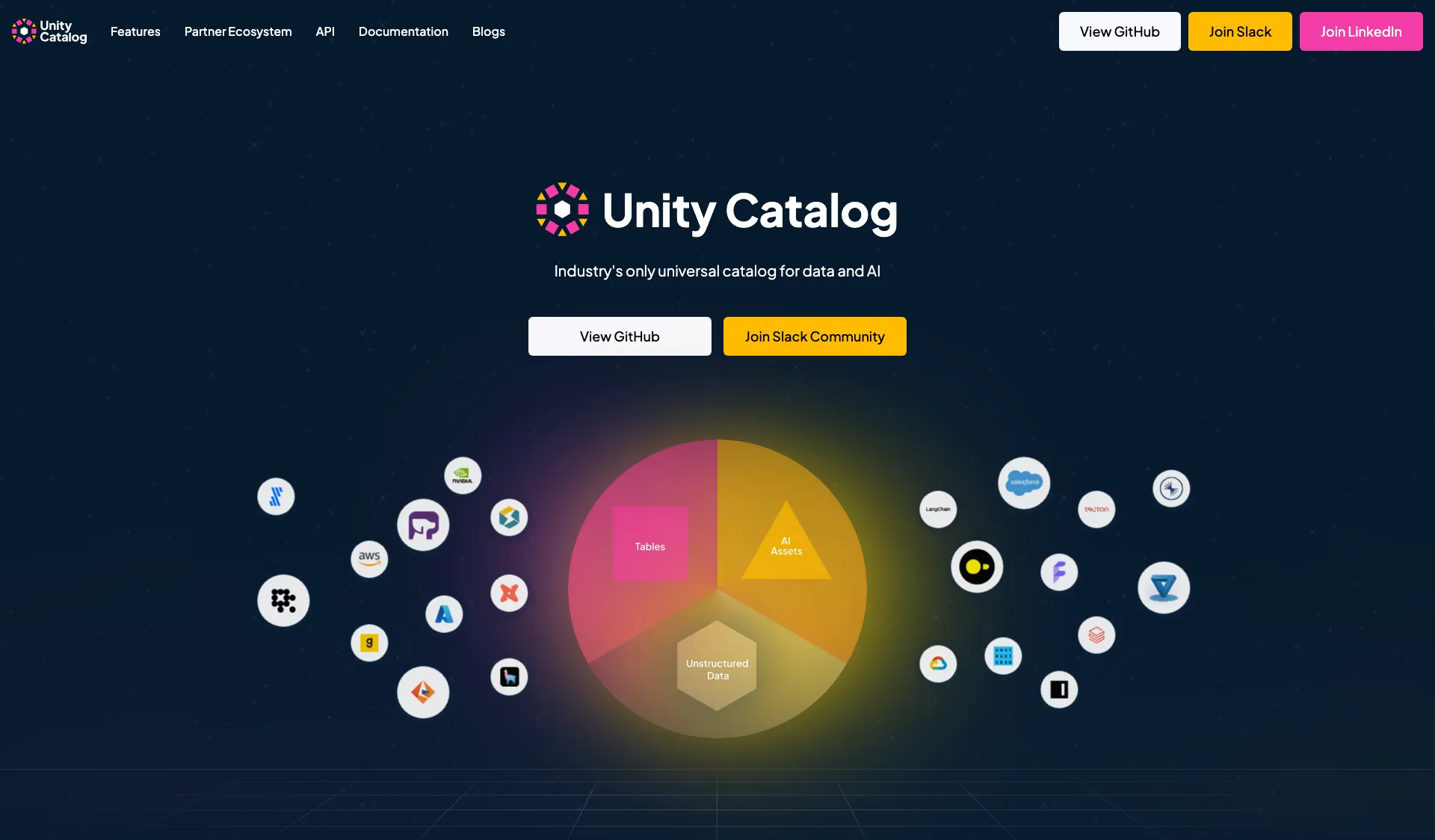
Unity Catalog is a catalog for data and AI assets, open-sourced by Databricks in 2024 and now hosted by the LF AI & Data Foundation.
 Unity Catalog
Unity Catalog governs more than tables: a three-level namespace covers tabular data (Delta Lake and Apache Iceberg), unstructured volumes, ML models, and functions under one permission model. It implements the Iceberg REST catalog API, so engines like Spark, Trino, and DuckDB read governed tables without a proprietary client.
Its governance model is enforcement-first — access control and temporary credential vending at the catalog layer, rather than documentation of assets after the fact. Note that the open-source project is a subset of the managed Unity Catalog inside Databricks, so evaluate the OSS feature set on its own terms. For lakehouse-centric teams, it is the most direct way to put open governance in front of the data itself.
Bytebase
Bytebase is an open-source database governance platform — it controls how database changes are made, who can access production data, and keeps a full audit trail.
The four platforms above govern data after it lands downstream. Bytebase governs the upstream source: change review, deployment approval, access control, and compliance auditing on the production databases themselves. It supports 25+ databases including PostgreSQL, MySQL, SQL Server, Oracle, and MongoDB.
Key governance capabilities:
- Change review and approval — every DDL/DML change goes through a structured workflow with 200+ SQL review rules enforced before execution. Enterprise tier adds custom multi-tier approval workflows.
- Role-based access control — workspace and project-level roles control who can view, query, or modify each database. Pro tier adds SSO integration.
- Audit logging — every query, schema change, login, and permission change is logged with the real user's identity, timestamp, and full SQL text. Available on Pro and Enterprise.
- Dynamic data masking — mask sensitive columns in query results based on user roles and semantic types, without changing the underlying data. Enterprise tier.
- Just-in-time data access — grant temporary, time-limited access to sensitive databases for emergency debugging, with automatic expiration.
- Multi-environment deployment — enforce dev → staging → production pipelines so changes are tested before reaching production.
Bytebase is MIT-licensed with commercial features (Enterprise) for advanced governance needs. It complements the data governance platforms above — they catalog what data exists downstream; Bytebase governs how it's changed and accessed at the source.
Conclusion
- OpenMetadata is the all-in-one stewardship platform: discovery, lineage, quality, and classification in a single deployment.
- DataHub is the programmable metadata graph, with streaming ingestion and the largest community in the space.
- Apache Gravitino federates metadata across heterogeneous systems and is growing into a governance control plane.
- Unity Catalog enforces lakehouse governance across tables, unstructured volumes, and ML models under one permission model.
- Bytebase covers database governance: change review, access control, data masking, and audit logging on the production databases that feed everything above.
Most teams need coverage on both sides of the line. Start where the pain is: if analysts can't find or trust data, start downstream with a catalog. If schema changes ship to production unreviewed, or engineers query production through a shared admin credential, start upstream with database governance.
For a deeper treatment of where the line runs, read Data Governance vs. Database Governance: The Difference Is the Base.
FAQ
What is database governance?
Database governance is the set of policies, processes, and tools that control how production databases are changed and accessed: schema migrations reviewed before deployment, access granted by role instead of shared credentials, sensitive columns masked, and every query and change audit-logged. It is owned by engineering — not the data team — and it operates on the operational databases upstream of the warehouse.
What is the difference between data governance and database governance?
Data governance governs the analytical estate — the data warehouse and data lake. It answers "what does this data mean, and can I trust it?" through catalogs, lineage, classification, and quality checks. Database governance governs the production databases upstream. It answers "who can change or query this database?" through change review, access control, masking, and audit logging. OpenMetadata, DataHub, Apache Gravitino, and Unity Catalog are data governance tools; Bytebase is a database governance tool.
Why does a database governance list include data governance tools?
Because the two terms are used interchangeably in practice — most searches for one mean the other, and most results for either return data governance platforms. Covering both keeps the categories straight: the catalogs govern the downstream copy, database governance controls the upstream source, and a complete program needs both.
Why aren't Apache Atlas and Amundsen on this list?
Both were fixtures of earlier editions. Amundsen's last release shipped in August 2024 and development has effectively stopped. Apache Atlas is in maintenance mode and only makes sense inside a Hadoop estate, where it remains the native governance layer alongside Apache Ranger. Existing deployments still work; for a new evaluation in 2026, start with the tools above.
Which governance tool should I choose?
It depends on the problem in front of you. If analysts can't discover or trust data, start with OpenMetadata or DataHub. If your metadata is scattered across heterogeneous systems or your estate is lakehouse-centric, look at Apache Gravitino or Unity Catalog. If you need to control schema changes, enforce SQL review, manage access permissions, and maintain an audit trail on production databases, start with Bytebase. Mature programs run one of each: a catalog downstream, database governance upstream.