Database automation manages database tasks with minimal human intervention. Schema changes. Deployments. Access provisioning. Audit. The result: fewer errors, consistent policy, DBAs working on architecture instead of approving every ALTER TABLE.
Six levels, named after the autonomous-driving framework. Each level removes a class of manual work and exposes the next bottleneck.
The 6 levels at a glance
| Level | Name | What's automated | What still needs a human | Typical tooling |
|---|---|---|---|---|
| L0 | No automation | Nothing | Everything | Direct DB clients |
| L1 | Ticketing | Request, approval, audit trail | Execution, review | Jira, ServiceNow + DB client |
| L2 | Version controlled | Schema history, change scripts | Deployment | Git + migration files |
| L3 | Streamlined | Deployment via CI/CD | Cross-tool stitching | Liquibase, Flyway, CI runner |
| L4 | Integrated | Change + ad-hoc access + audit in one platform | Strategic decisions | Bytebase, equivalent platforms |
| L5 | Fully automated | End-to-end including self-healing | Oversight only | Aspirational |
Level 0 — No Automation
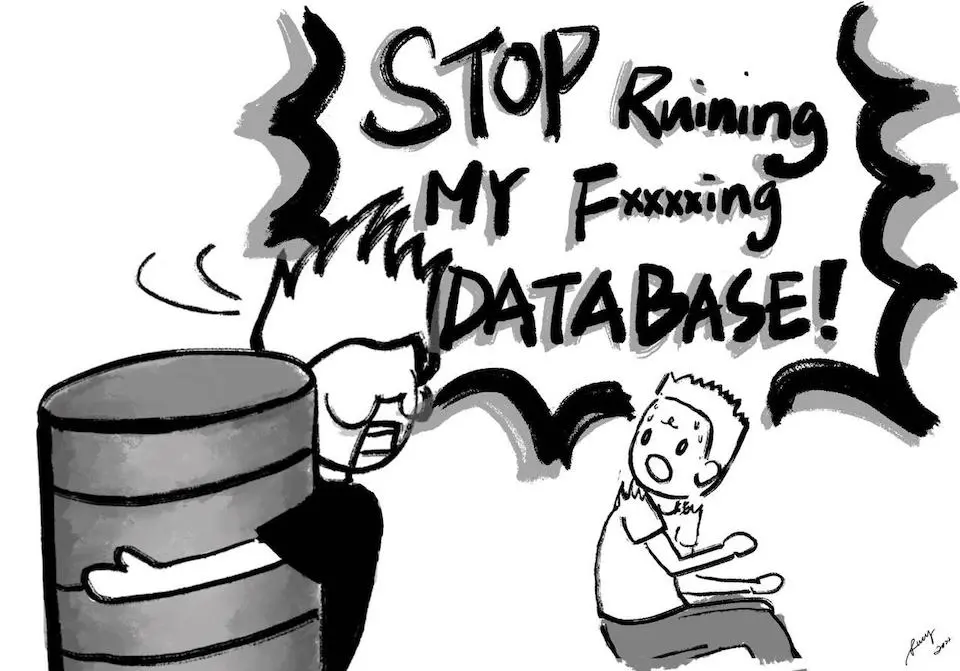
Level 0 is when every database task is done by hand, with no system between the operator and the database. Most teams never officially leave it. Higher-level tooling accumulates on top while one-off operations stay manual underneath.
- Manual changes — DBAs run SQL from a database client.
- No version control — no history of who changed what when.
- Permission sprawl — access granted by hand, outliving its reason.
- No audit trail — reconstructing what happened needs log forensics.
Level 1 — Ticketing
Level 1 is when a ticketing system gates database changes — Jira, ServiceNow, or similar. The change itself is still executed manually. Most organizations sit here. The system records the request, approval, and audit trail. It does not prevent a typo from reaching production.
- Ticketing system tracks the request and decision.
- Approval gates the change.
- Approver hands the ticket to a DBA, who opens a client and runs the SQL.
- Audit lives in the ticket. Searching across many tickets is hard.
Level 2 — Version Controlled
Level 2 is when schema changes live in version control alongside application code, as migration files committed to Git. Teams that have adopted DevOps for application code reach this level for the database next.
- Schema and migrations tracked in Git.
- Each change is a versioned SQL file, applied in order.
- Pull-request review on schema changes.
- Deployment is still manual — someone runs the tool against an environment.
Level 3 — Streamlined
Level 3 is when database changes deploy through a CI/CD pipeline. Rollback and environment promotion built in. Migration tools apply changes deterministically without a human running them.
- CI/CD applies changes to dev, staging, prod.
- Liquibase or Flyway manage the apply-and-track loop.
- Failed deployments roll back automatically (within SQL's limits).
- Gap: ad-hoc work — emergency fixes, transient access grants — still bypasses the pipeline.
Level 4 — Integrated
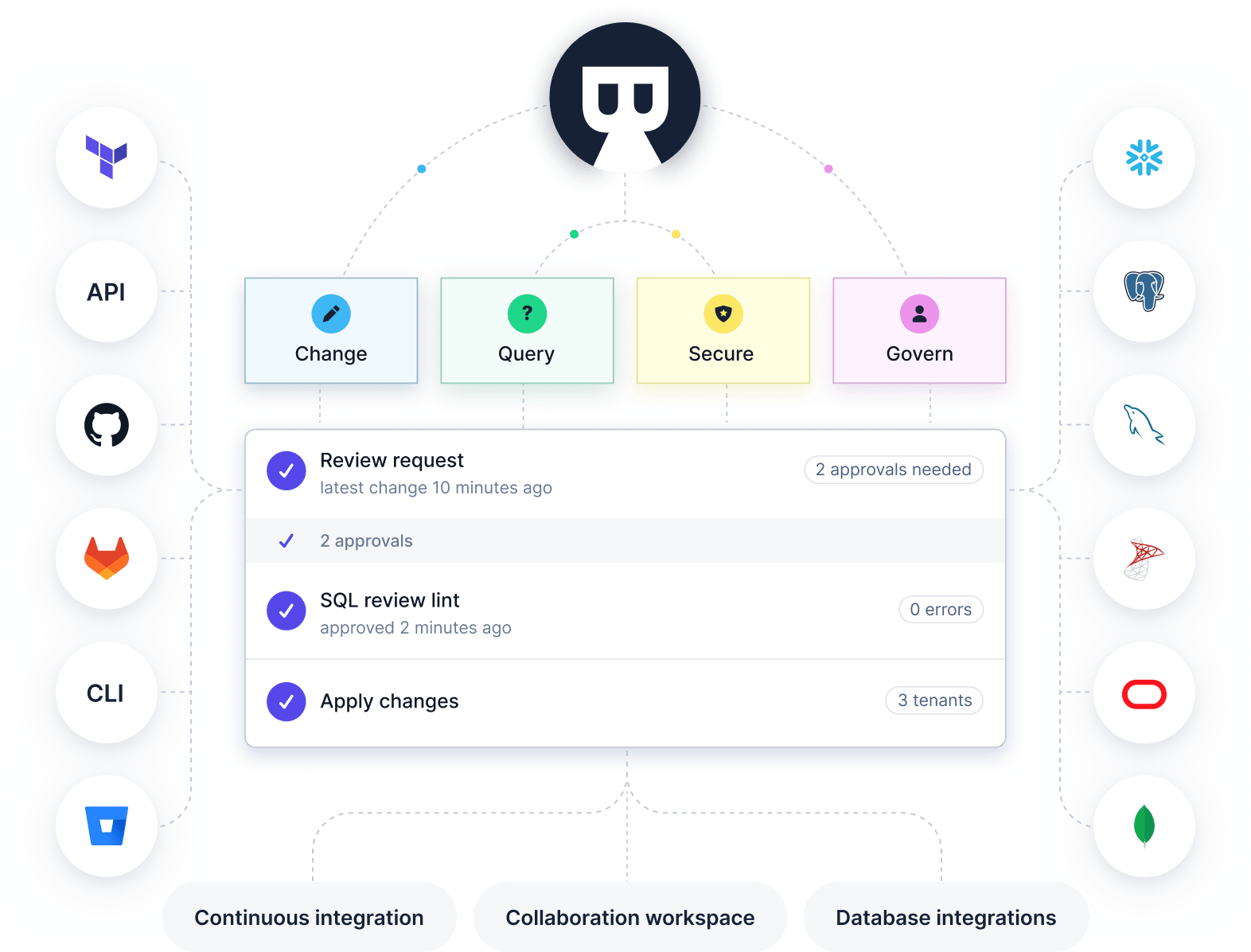
Level 4 is when planned changes and ad-hoc tasks live in the same platform, with shared approval, audit, and access models. L2 and L3 handle planned changes. Ad-hoc work — patching a row, granting a temporary credential, running a one-off ANALYZE — falls outside the version-controlled model. L4 closes the gap.
- Schema changes and ad-hoc operations flow through the same pipeline.
- One-off access grants follow the same approval flow as schema changes.
- Standing permissions sync from external identity providers (Okta, AD, LDAP).
- All human-to-database actions land in one searchable audit log.
Bytebase operates at Level 4. Schema changes, data changes, ad-hoc access, and permission grants flow through one workflow. One audit log captures all of it.
Level 5 — Fully Automated
Level 5 is fully automated end-to-end. Self-healing systems handle failures. No human handles routine operations — the database equivalent of a robotaxi. No production team operates here today.
- End-to-end automation from request to deployment to monitoring.
- Self-healing: automatic rollback when monitoring detects regressions.
- Compliance and security checks built into the pipeline.
Whether L5 should be a goal is contested. Most teams keep a human approving destructive operations.
Where most teams sit
Across the database teams we work with: L0 ~5% (early-stage), L1 ~40% (most enterprise teams), L2 ~25%, L3 ~20% (CI/CD for schema, ad-hoc still outside), L4 ~10% (compliance-driven), L5 0%.
L1 is the most exposed cluster. Governance is in place — tickets, approvals, audit. Execution safety is not. A typo in production looks the same at L1 as at L0.
FAQ
What is database automation? Database automation manages database tasks — schema changes, deployments, access provisioning, audit — with minimal human intervention. The result: fewer errors, consistent policy, DBAs working on architecture instead of approving every change.
What are the 6 levels of database automation? Six levels, named after the autonomous-driving framework. L0 No Automation. L1 Ticketing (approval, manual execution). L2 Version Controlled (schemas in Git). L3 Streamlined (CI/CD deployment). L4 Integrated (planned and ad-hoc tasks in one platform). L5 Fully Automated (end-to-end with self-healing).
Is database CI/CD the same as database automation? Database CI/CD is one layer — Level 3, automated deployment of planned schema changes through a pipeline. Full automation also covers governance (L1), version control (L2), and ad-hoc work that doesn't fit a pipeline (L4). A team running Liquibase in GitHub Actions has database CI/CD. It is not yet at Level 4.
What tools enable database automation? Jira or ServiceNow for L1 ticketing. Git plus migration files for L2. Liquibase or Flyway in CI/CD for L3. Platforms like Bytebase that combine schema change, ad-hoc access, and audit for L4. Most teams run a mix — Jira for governance, Flyway for apply. The gap between them is what L4 platforms close.
How mature is database automation today? Most enterprise teams sit at Level 1 (~40%) or Level 2 (~25%). About 20% have reached Level 3 with CI/CD pipelines for schema changes. Roughly 10% have closed the ad-hoc gap at Level 4. Level 5 is not in production at any team we've worked with.
What's the highest level of database automation? Level 5 — end-to-end automation with self-healing, no human handling routine operations. Theoretical highest, not deployed. No production team runs without human approval for destructive operations. Most explicitly choose not to. Level 4 is the highest seen in production.