Before getting into database PAM, let's review what plain PAM is.
Privileged access management (PAM) controls the accounts that can do real damage: root on a Linux box, admin on the cloud console, the superuser of a production database. The playbook has been stable for two decades. Vault the credential. Rotate it. Broker the session: requested, approved, time-boxed, revoked. Record everything for the auditors. CyberArk, BeyondTrust, Delinea, StrongDM, Teleport: different generations of products, same playbook.
That playbook was written for servers, and for servers it is the right one. The dangerous moment with SSH is the connection itself. Control who gets a shell, keep a recording, and you have answered the question that matters: did anyone unauthorized get in?
Then the same broker gets pointed at a database, and nothing visibly breaks. Credential vaulted, session recorded, compliance box checked. But the database has been quietly treated as just another server, and it is not one. On a server, the unit of risk is the connection. On a database, it is the statement.
Database PAM is privileged access management where the unit of control is the SQL statement, not the connection.
A perfectly authorized engineer on a perfectly brokered connection is one missing WHERE clause away from taking production down, and the session recorder will faithfully capture it happening.
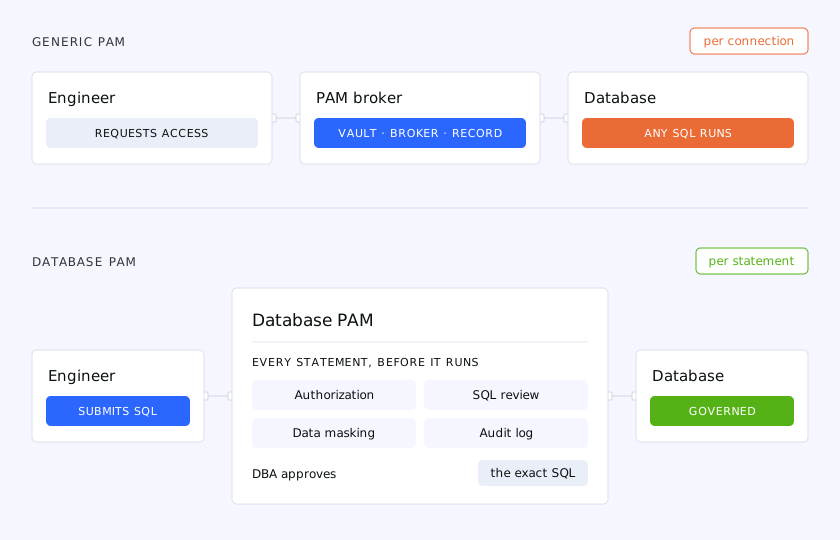 Generic PAM brokers the connection and any SQL runs; database PAM authorizes, reviews, masks, and audits every statement
Your codebase solved this years ago
Look at what it takes to change code at any serious engineering org. An SSO login gets you into GitHub. That is connection-level control, and nobody pretends it is the control that matters. Everything that matters operates on the change itself. CODEOWNERS decides who can touch which paths. The pull request is approved on the exact diff, not on "Alice may merge things this afternoon." CI runs before the merge, not after the outage. Push protection blocks the AWS key before it lands in history. And git log attributes every line to an author, forever.
Nobody expects SSO to read a diff. And nobody answers "who changed the payment logic?" by scrubbing through a screen recording of someone using GitHub.
That is statement-level control. Code just calls the statement a diff. It has been table stakes for over a decade, yet the database is the one place where "you are connected, good luck" still passes as governance. Generic PAM is the SSO login. Database PAM is everything your code workflow does after it.
What statement-level control consists of
The code workflow maps onto the database one to one. Five pieces.
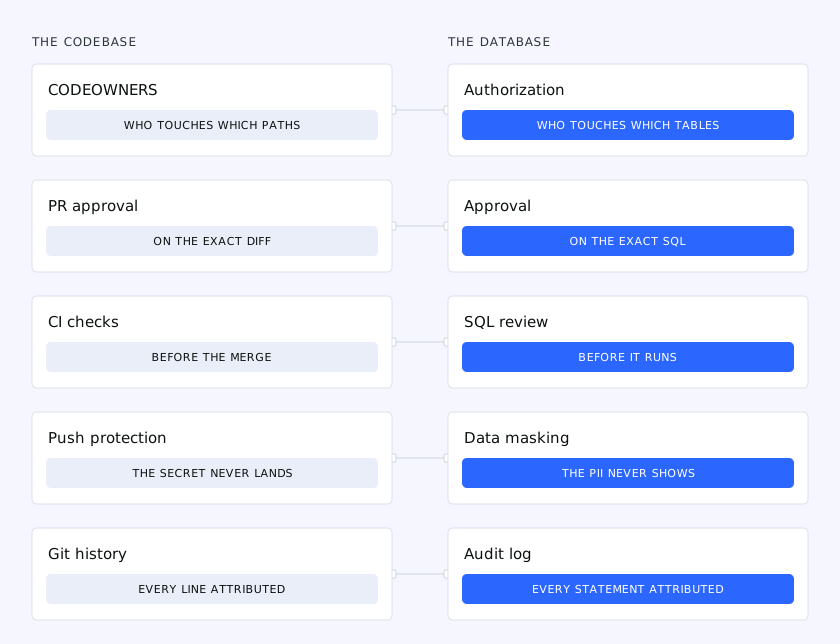 The code workflow mapped onto database PAM: CODEOWNERS to authorization, PR approval to per-query approval, CI checks to SQL review, push protection to data masking, git history to the audit log
1. Authorization per statement
Connection-level authorization says Alice has read access to prod for four hours. Statement-level authorization says Alice can SELECT from orders but not from users.ssn, can query but not export, can run DML with approval but never DDL, scoped per environment. The grant follows what the SQL touches, not the wire.
2. Approval that attaches to the query
Just-in-time access in generic PAM ends in a credential: here is your four-hour session. In database PAM the request ends in a statement. The approver sees the actual DELETE, risk-scored by what it touches: which tables, how many rows, prod or staging.
3. Review before execution
This is the CI gate for SQL, and it has no generic-PAM equivalent at all. The statement gets parsed and checked before it runs: the UPDATE without a WHERE, the migration that locks a hot table at noon. This is the class of incident that starts with "the query looked fine." A session recorder watches it happen; a reviewer stops it first.
4. Masking on the read path
Classification finds the sensitive columns the way secret scanning finds keys: this column is PII, that one is financial. Masking is the push protection on top: an engineer with a valid session and a valid grant still sees j***@gmail.com in the query result, unless an approved, logged exemption says otherwise. A recorder can only record the secret being revealed in full.
5. Audit at the statement
A recorded 30-minute session is a 30-minute video. To answer "who deleted rows from orders last Tuesday," someone has to find every session that touched orders and watch them. Let's be honest: nobody watches the video. A statement-level log makes it one query: user, timestamp, full SQL text, rows affected. That is the format a SOC 2 auditor actually asks for.
Why generic PAM stops at the connection
Not laziness. Architecture and economics.
A PAM broker is a protocol proxy, deliberately generic so one gateway can front SSH, RDP, Kubernetes, and databases alike. Operating at the statement means a SQL parser per dialect (PostgreSQL is not Oracle is not MongoDB), live schema awareness to know that users.ssn is sensitive, and a risk model per statement type. That is not a feature you bolt onto a proxy. That is a database product.
And a horizontal vendor covers servers, endpoints, cloud consoles, and secrets across the whole estate. Going statement-deep on one slice of that estate is a vertical business. This is the T-shape: the horizontal bar brokers access to everything, the vertical stem goes all the way down one thing. Both are legitimate products. They are just not the same product, which is why "we already have PAM" and "we need database PAM" are both true in the same company.
Do you need one?
Check three things: who touches production, what lives in it, and what you can prove afterward.
If support engineers, on-call, or analysts run SQL against production, the exposure exists, and connection-level control does nothing about it. If the database holds PII, payments, or health records, that exposure is expensive. And if the honest answer to an auditor's "what ran?" is a pile of session videos, the gap has already surfaced.
This is not a rip-out-your-PAM argument. The rest of the estate still needs the broker. The move is to give the database what the codebase has had all along: control at the statement, where the risk actually lives.
This is the product we build. Bytebase is a database PAM: statement-level authorization, just-in-time access with per-query approval, SQL review, dynamic data masking, and a statement-level audit log, across PostgreSQL, MySQL, and 30-some other engines. For how it sits next to a horizontal PAM you already run, see Bytebase vs. PAM.
After all, the most privileged access to a database is the SQL statement itself, and that is the access database PAM manages.