Backing up PostgreSQL is essential for reliability and disaster recovery. The open-source ecosystem offers several strong tools - each with unique design goals, languages, and ideal use cases.
Below is a curated list of the top PostgreSQL backup solutions, compared across multiple dimensions: language and ideal use cases.
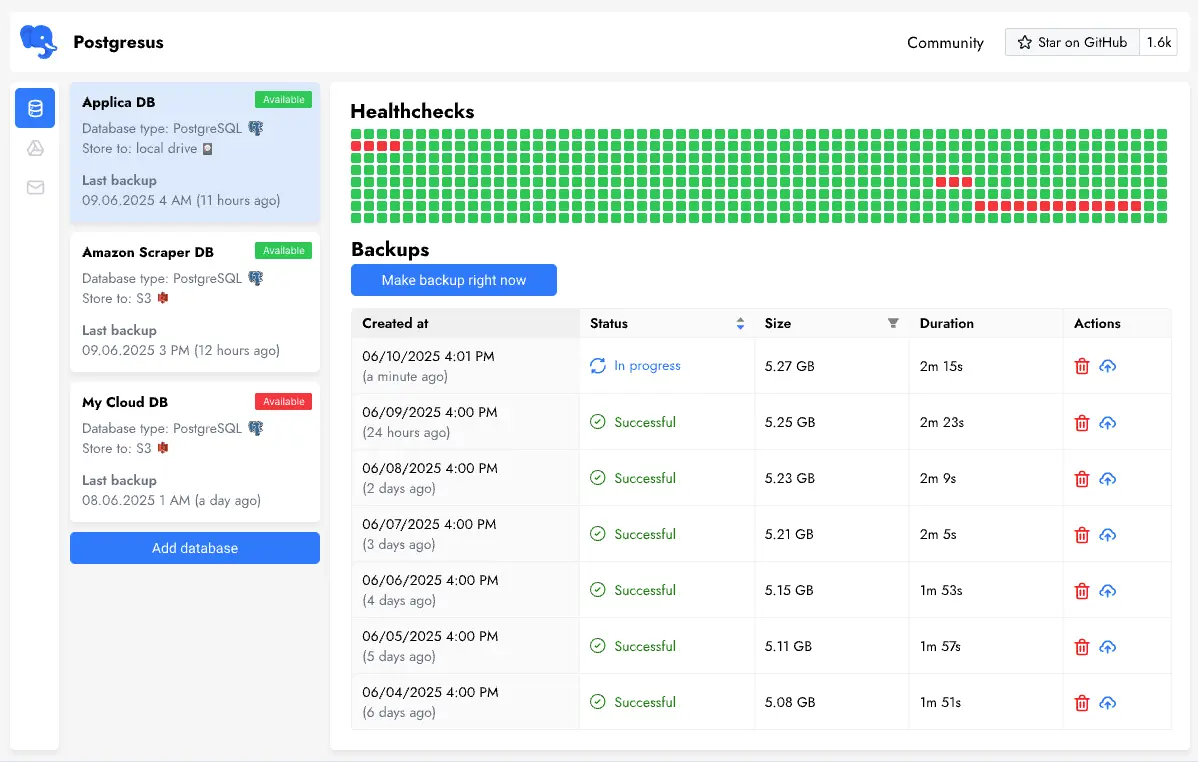
Databasus
- GitHub: https://github.com/databasus/databasus
- Language: Go + TypeScript
- Maintainer: Community
- License: Apache 2.0
- Interface: Web UI
- Supported Databases: PostgreSQL, MySQL, MariaDB, MongoDB
- Best For: Teams needing a self-hosted, web-based backup management solution
Databasus (rebranded from Postgresus) is a self-hosted database backup management tool with a modern web UI. It offers flexible scheduling (hourly, daily, weekly, monthly, or cron), multiple storage destinations (S3, Google Drive, NAS, SFTP), AES-256-GCM encryption, and team features like role-based access control and audit logging. Notifications are supported via email, Telegram, Slack, Discord, and webhooks.
WAL-G
- GitHub: https://github.com/wal-g/wal-g
- Language: Go
- Maintainer: Community
- License: Apache License 2.0
- Interface: CLI
- Supported Databases: PostgreSQL, MySQL/MariaDB, MS SQL Server, MongoDB (beta), Redis (beta)
- Best For: Cloud-native and multi-database environments
WAL-G is an archival and restoration tool for databases in the Cloud, the spiritual successor to WAL-E. It's built for performance, with parallel compression, encryption, and seamless cloud storage integration. Its multi-database support makes it ideal for teams managing mixed database stacks.
pgBackRest
No longer maintained as of April 2026. The pgBackRest repository was archived on April 27, 2026 and is now read-only. The maintainer cited the loss of corporate sponsorship after Crunchy Data was sold and the inability to find a sustainable funding model. v2.58.0 is the final release — no further bug fixes, security patches, or features. Existing deployments continue to work, but new setups in 2026+ should evaluate the alternatives below. A community fork may emerge under a new name.
- GitHub: https://github.com/pgbackrest/pgbackrest (archived)
- Language: C
- Maintainer: Formerly Crunchy Data — unmaintained as of April 2026
- License: MIT License
- Interface: CLI
- Supported Databases: PostgreSQL only
- Best For: Existing deployments only — not recommended for new setups
pgBackRest was designed for speed, reliability, and flexibility, supporting full, differential, and incremental backups with parallel processing, compression, encryption, and cloud storage integration. It was widely deployed in production through the early 2020s and remains functional at v2.58.0, but no longer accepts contributions. New deployments should consider WAL-G, Barman, or pgmoneta.
Barman
- GitHub: https://github.com/EnterpriseDB/barman
- Language: Python
- Maintainer: EnterpriseDB (EDB)
- License: GNU GPL 3
- Interface: CLI
- Supported Databases: PostgreSQL only
- Best For: Enterprises requiring centralized backup management
Barman (Backup And Recovery Manager) is an open-source administration tool for disaster recovery of PostgreSQL servers written in Python. It allows your organisation to perform remote backups of multiple servers in business critical environments to reduce risk and help DBAs during the recovery phase.
pgmoneta
- GitHub: https://github.com/pgmoneta/pgmoneta
- Language: C
- Maintainer: Community
- License: BSD-3-Clause
- Interface: CLI (daemon mode)
- Supported Databases: PostgreSQL only
- Best For: Teams needing efficient daemon-based backup with incremental support
pgmoneta is a backup and restore solution for PostgreSQL, named after the Roman Goddess of Memory. It runs as a daemon and supports full and incremental backups (PostgreSQL 14+), multiple compression options (gzip, zstd, lz4, bzip2), AES encryption, and WAL shipping. It features Prometheus monitoring integration, remote management capabilities, and TLS v1.2+ support. Built with a process-based model using shared memory and libev for efficient network operations.
pgBackWeb
pgBackWeb wraps pgBackRest, which was archived in April 2026. pgBackWeb itself remains active, but its underlying engine no longer receives updates. Long-term users may want to track whether pgBackWeb migrates to a different backend.
- GitHub: https://github.com/eduardolat/pgbackweb
- Language: Go + JavaScript
- Maintainer: Community
- License: AGPL-3.0
- Interface: Web UI
- Supported Databases: PostgreSQL (via pgBackRest — see notice above)
- Best For: Teams preferring visual management on existing pgBackRest deployments
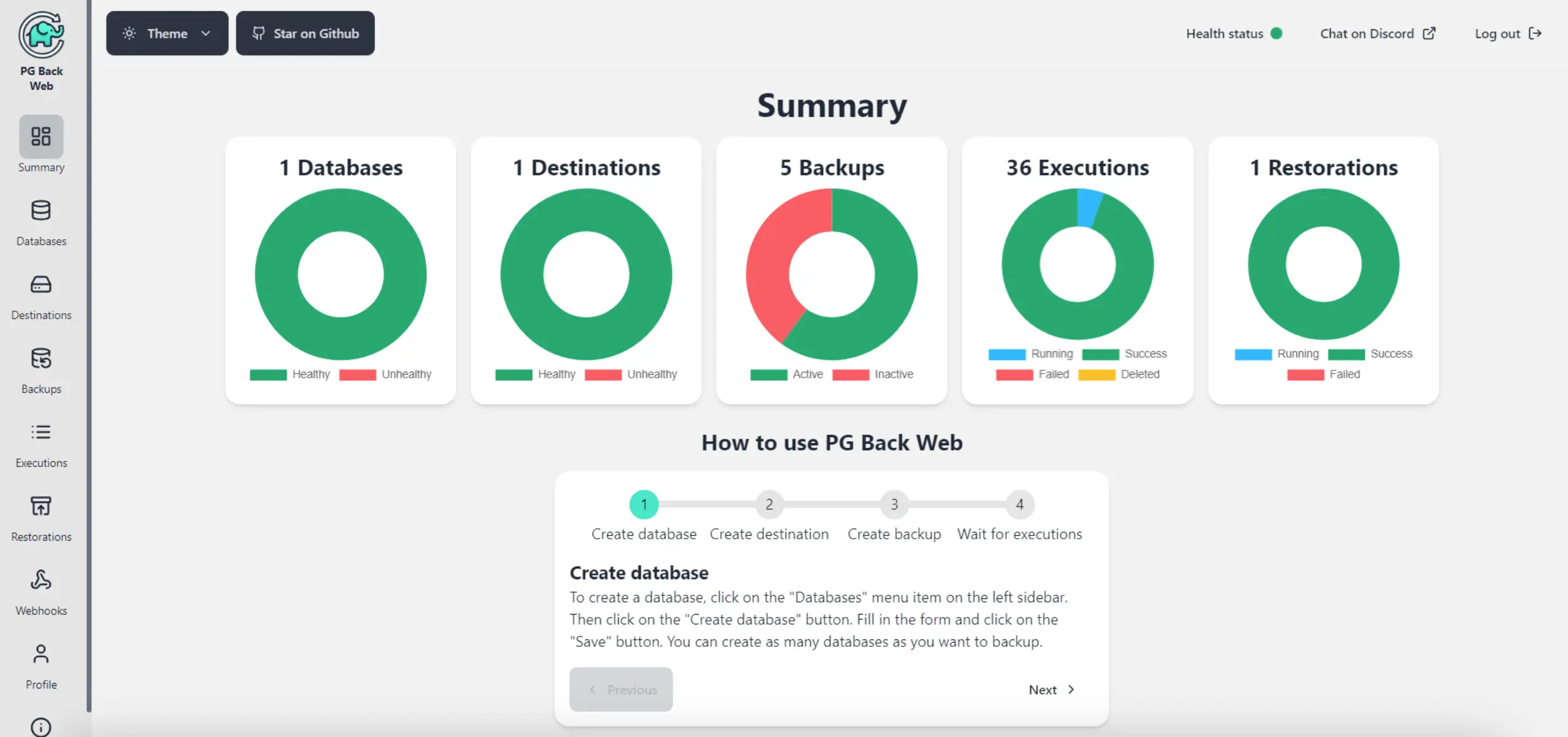
pgBackWeb provides a user-friendly web dashboard on top of pgBackRest. It enables visual monitoring, restore operations, and scheduling — ideal for smaller teams or users who prefer GUI-based workflows instead of the command line.
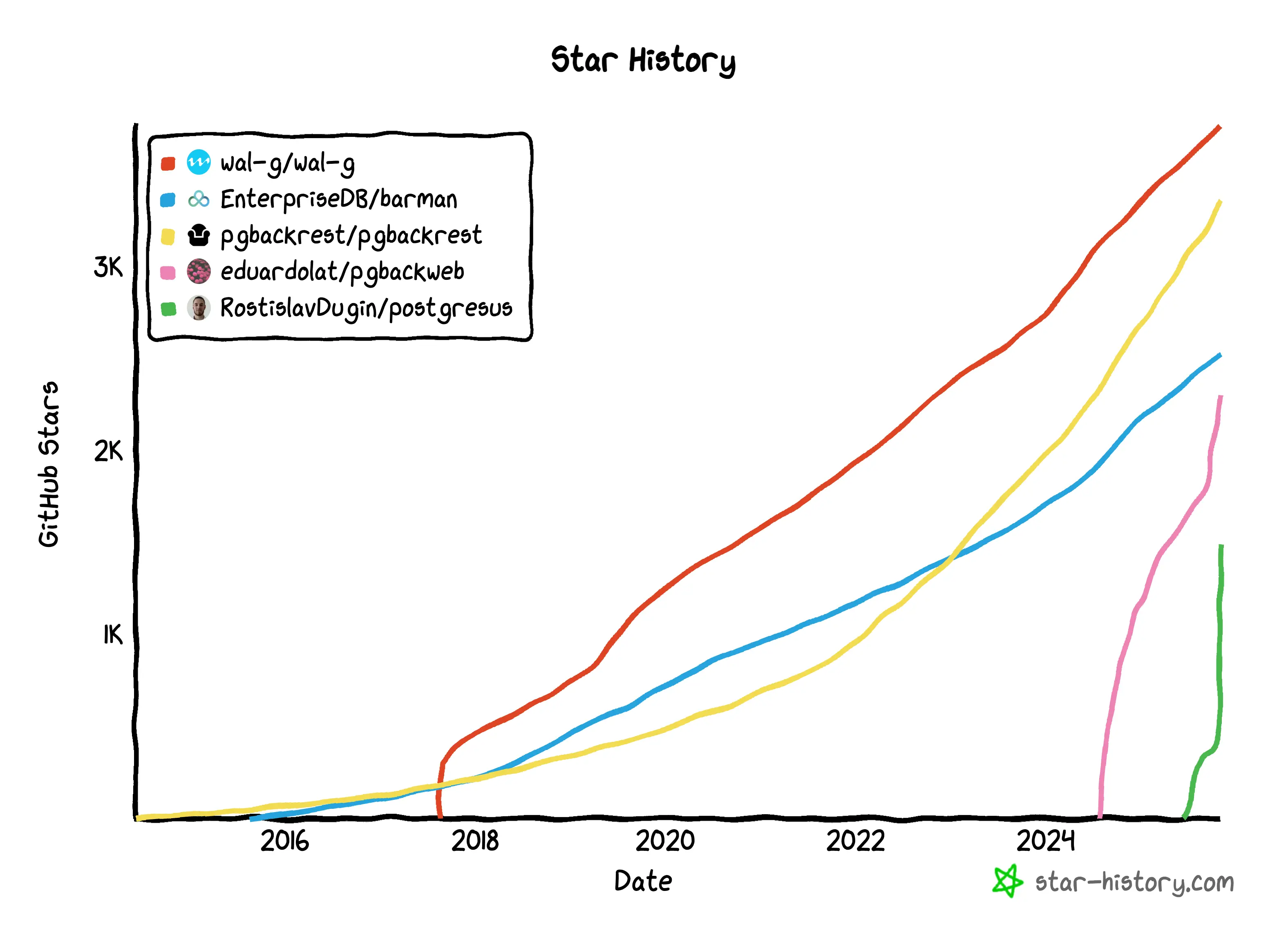
Comparison Table
| Tool | Language | License | Interface | Multi-DB Support | Cloud Storage |
|---|---|---|---|---|---|
| Databasus | Go + TypeScript | Apache 2.0 | Web UI | ✅ | ✅ |
| WAL-G | Go | Apache 2.0 | CLI | ✅ | ✅ |
| pgBackRest ⚠️ | C | MIT | CLI | ❌ | ✅ |
| Barman | Python | GNU GPL 3 | CLI | ❌ | ✅ |
| pgmoneta | C | BSD-3-Clause | CLI (daemon) | ❌ | ❌ |
| pgBackWeb | Go + JavaScript | AGPL-3.0 | Web UI | ❌ | ✅ (via pgBackRest ⚠️) |
⚠️ pgBackRest is no longer maintained as of April 2026 — see the pgBackRest section for details.
Choosing the Right Tool
- Databasus — great for teams wanting a self-hosted web UI with multi-database support.
- WAL-G — best for multi-database, cloud-native setups. Recommended for new PostgreSQL deployments.
- pgBackRest — feature-rich and battle-tested, but no longer maintained as of April 2026. Suitable only for existing installations; do not use for new deployments.
- Barman — fits enterprise environments with strict compliance. Recommended for new PostgreSQL deployments needing centralized management.
- pgmoneta — lightweight daemon-based solution with incremental backup and monitoring support.
- pgBackWeb — useful if you already run pgBackRest and want a GUI; reconsider for new setups given the underlying engine's archival.
Each project offers a unique trade-off between simplicity, scalability, and ecosystem support. Pick based on your environment’s scale, cloud strategy, and team expertise.