A common data masking architecture goes like this. Stream every production database into the warehouse through CDC. Mask sensitive columns during transformation. Revoke direct production access and point every human at the warehouse. Masking is solved once, by the team that owns the pipeline.
Masking in the warehouse is analytics architecture. It is not dynamic data masking for production.
Three reasons. Cleartext exists at every hop before dbt. dbt produces one masked value per column. And the people with the riskiest access never moved to the warehouse.
The warehouse data masking architecture
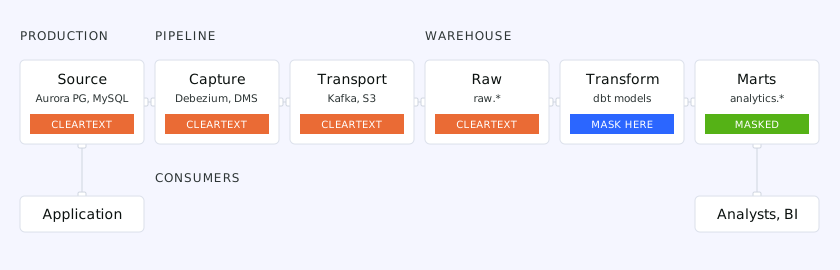 CDC pipeline from Aurora through Debezium, Kafka, and the raw warehouse schema to dbt and the analytics marts, with cleartext at every layer before dbt
| Layer | Component | Holds |
|---|---|---|
| Source | Aurora PostgreSQL, Aurora MySQL, RDS for SQL Server | Cleartext |
| Capture | Debezium on MSK Connect, or DMS | Cleartext |
| Transport | Kafka topics, S3 landing zone | Cleartext |
| Raw | raw.* in Snowflake, Redshift, BigQuery | Cleartext |
| Transformation | dbt models | Mask here |
| Marts | analytics.* | Masked |
-- models/staging/stg_customers.sql
select
  customer_id,
  sha2(lower(email), 256)                        as email_hash,
  concat(repeat('X', 5), right(account_no, 4))  as account_no_masked
from {{ source('raw', 'customers') }}
Production security groups admit the application and the connector. Warehouse roles grant analytics.* to everyone and raw.* to data engineers. On paper, no human reads cleartext.
Where warehouse masking falls short
Operators never left production
Someone runs the migration. Someone applies the data fix when it goes wrong. The on-call engineer reads the row the application wrote forty seconds ago, in the OLTP schema. A star-schema copy that is minutes behind cannot answer why that write failed. Support looks up the live account with the customer on the phone. The warehouse also does not hold the config database, the table excluded for size, or the one added last week.
These readers keep production credentials, usually with no masking on their path and often no audit. This is Conway's law. The data team built masking in the data team's tools for the data team's readers. Production belongs to the DBA or platform team, and nobody built anything there, because the premise was that nobody reads it. Two policies drift, and nobody owns the boundary.
Cleartext precedes the mask
Everything upstream of dbt is production data in the clear. Each copy has its own retention and its own access model. The WAL held for the replication slot. Debezium's after images in Kafka topics, kept 7 days by default under Kafka ACLs. The S3 landing zone. And raw.*, which data engineers read by design. Snowflake time travel keeps the raw table's history queryable for up to 90 days on Enterprise, and a production delete has to be repeated in every copy.
DMS masking transformations and Kafka Connect's MaskField can mask earlier. Do that where the data stays useful. The source, its WAL, and the capture process still see the value.
One masked value per column
A dbt model is a static function of the source row. The reader's role is not an input. Support needs the last four digits, fraud needs the full number, analysts need a joinable hash. Serving three audiences means three marts. Or you turn on the warehouse's own masking policies, CREATE MASKING POLICY ... CASE WHEN CURRENT_ROLE() .... That puts you back on dynamic data masking, with roles to map and unmasking to audit, for the warehouse only. Production still has none.
Policy changes reprocess history
Take a multi-TB Aurora PostgreSQL database with the SSN at an unknown depth in JSONB. Incremental models handle the steady state. A policy change reparses every document in history. At TB scale that is a multi-day backfill, so the policy stops changing. Until the refresh lands, materialized marts serve the old value. And the model flattens the document, so the engineer debugging why the application wrote it cannot see the original.
What production data masking needs
The answer is not to tear down the warehouse. It is dynamic data masking on the production database, on the path operators use. Four properties:
- Role-bound and column-level. The reader's role is an input to the mask, so support, fraud, and on-call get different values from the same row.
- Enforced on every read, not only the projection. A mask that applies only to the
SELECTlist answersWHERE ssn = '123-45-6789'against the raw value. The column has to be masked wherever it appears:WHERE, joins, subqueries,RETURNING. - A logged unmask path. Someone will legitimately need the real value. The grant is scoped and time-boxed, and every unmasked read is tied to a person and a reason.
- Policy as code, the discipline the dbt project already has.
Even with all four, masking only limits what a query reveals. SQL Server's DDM masks the projection alone, so a reader can probe with WHERE ssn LIKE '123%', which is why Microsoft's DDM guidance pairs it with least privilege and auditing. Item 3 is the auditing half.
Dynamic data masking on the production database
AWS reached the same conclusion. Aurora PostgreSQL has native dynamic masking through pg_columnmask on 16.10+ and 17.6+, applied in the query rewrite stage, so the masked-view leak does not apply:
CALL pgcolumnmask.create_masking_policy(
    'mask_accounts', 'public.accounts',
    JSON_BUILD_OBJECT(
        'account_holder_name',   'pgcolumnmask.mask_text(account_holder_name)',
        'account_contact_email', 'pgcolumnmask.mask_email(account_contact_email)'
    )::JSONB,
    ARRAY['analyst'], 50
);
Two limitations. It is locked to one engine on one vendor: Aurora PostgreSQL only, not Aurora MySQL, not RDS. And the policy lives inside the database. Roles are database roles, so mapping them to the people in your SSO or SCIM directory is your problem, one database at a time.
Bytebase answers both. One masking policy covers MySQL, PostgreSQL, SQL Server, Oracle, MongoDB, and more on any cloud. The policy binds to Bytebase users and groups, which come from your SSO and SCIM, not to database roles. It masks what flows through it, so direct database paths have to be closed, and it does not mask the application's own connection.
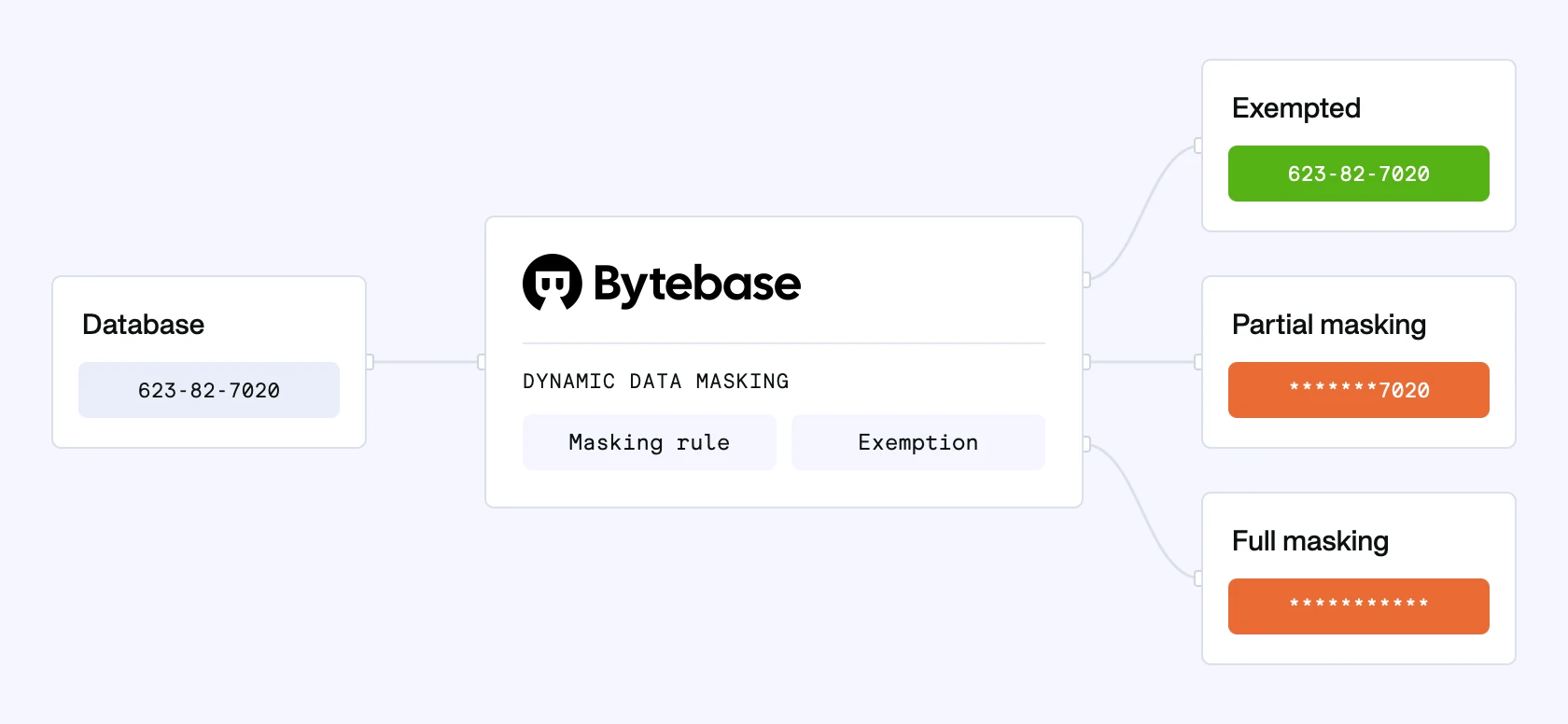 Bytebase dynamic data masking: one database value, a masking rule and an exemption in Bytebase, and three readers seeing the exempted value, a partially masked value, and a fully masked value
Masking is enforced per path. The warehouse governs one. Production is the other, and it is still open.
References
- Protect sensitive data with dynamic data masking for Amazon Aurora PostgreSQL
- SQL Server Dynamic Data Masking