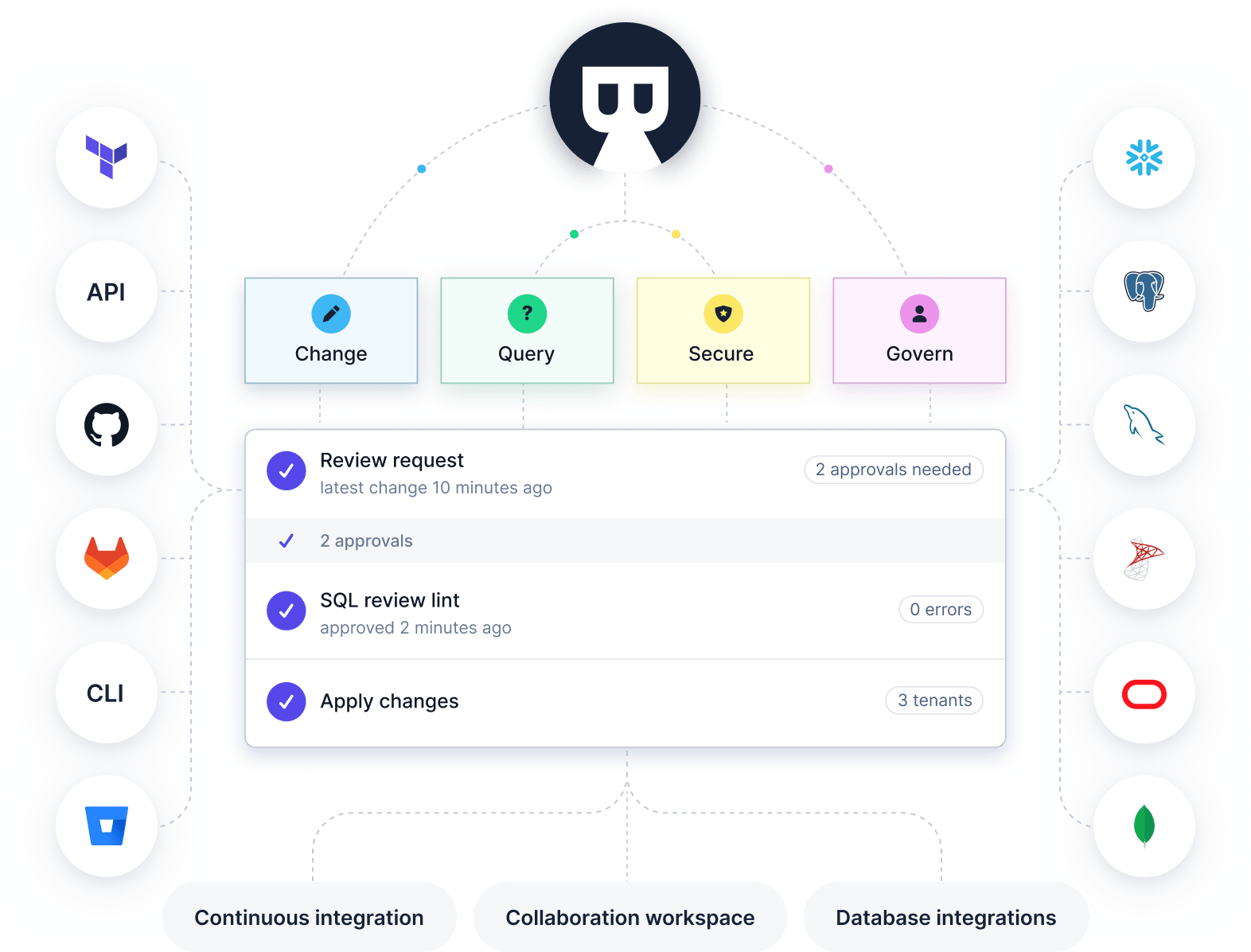
This post is maintained by Bytebase, an open-source database governance platform that can manage both MySQL and MariaDB. We update the post every year.
MySQL 8.0, the version most of the world still runs, reached end of life in April 2026 with its final 8.0.46 release. No more security patches. If you are on 8.0, you are picking an upgrade path anyway, so you might as well re-ask whether that path leads to MySQL or MariaDB. Both sides also reset their release lines: Oracle shipped MySQL 9.7 as the new LTS, and MariaDB's current LTS is 11.8.
At Bytebase, we work with both databases extensively since the Bytebase product needs to integrate with both databases. Our founders also build Google Cloud SQL. Drawing from our operational experience, we outline below the respective strengths of MySQL and MariaDB:
Unless otherwise specified, the comparison below is between the current LTS releases, MySQL 9.7 vs. MariaDB 11.8.
Popularity
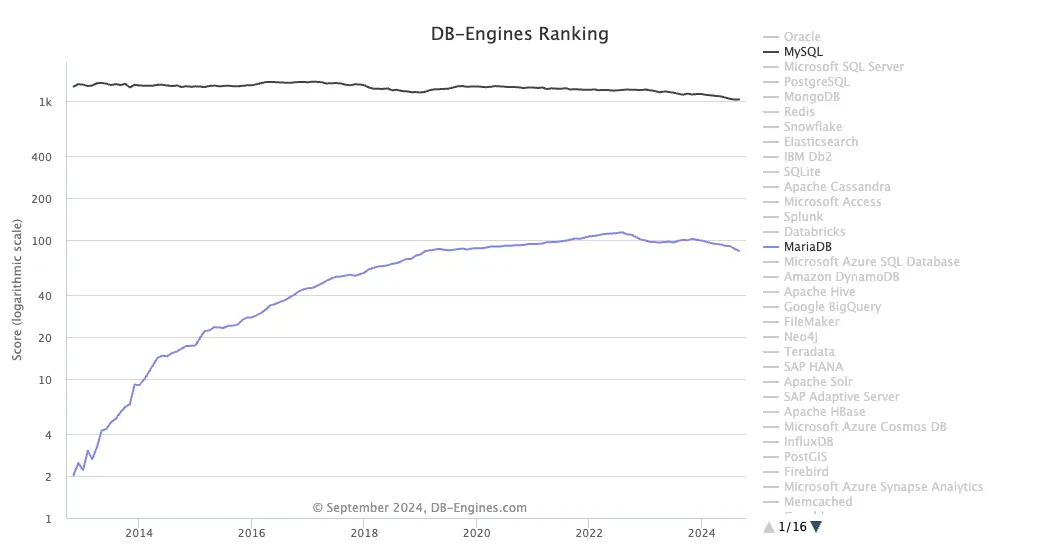
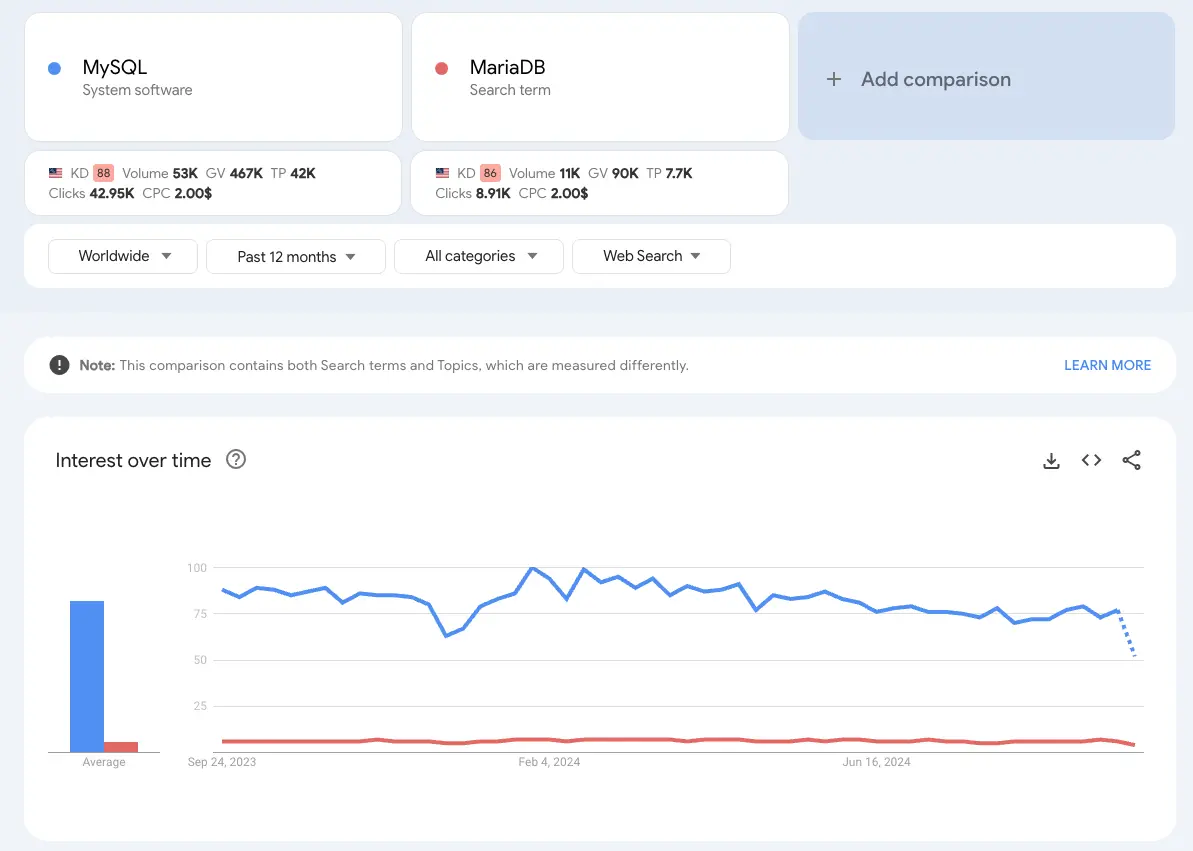
MySQL as the world's most popular open source database, is still overwhelmingly more popular than MariaDB.
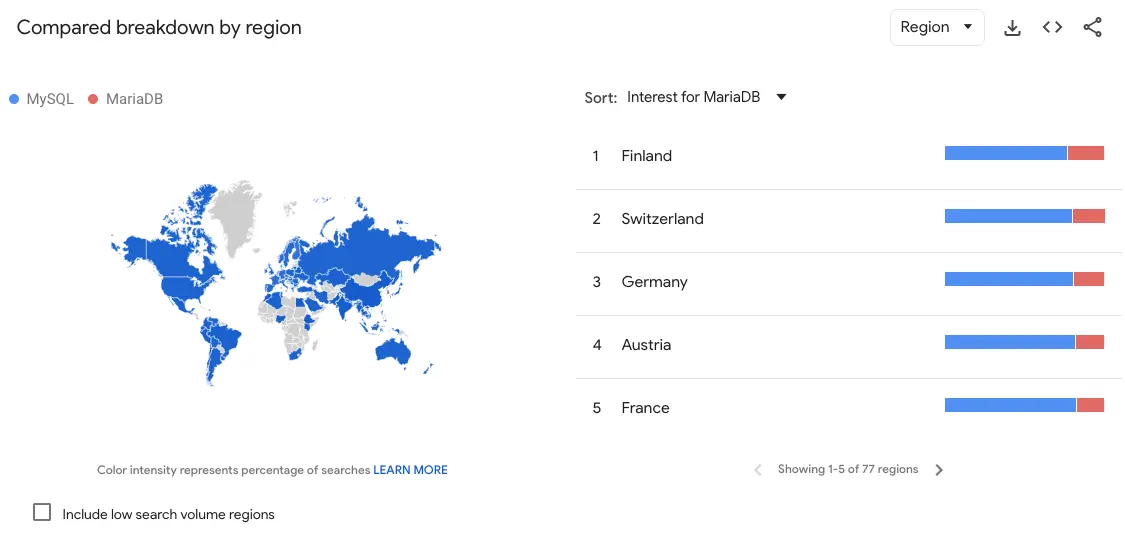
MariaDB itself is more popular in Europe than the rest of the world.
License
MySQL employs dual licensing model:
-
GPL (General Public License) Version 2: MySQL's open-source version is licensed under the GNU GPL v2. This means that if you use MySQL in a project that is also open-source and licensed under the GPL, you can use MySQL without purchasing a commercial license.
-
Proprietary License: If you want to embed or distribute MySQL in a closed-source or proprietary product, you need to obtain a commercial license from Oracle, the company that owns MySQL. This is often used by companies that don't want to comply with the GPL terms.
MariaDB is licensed under GPLv2. It remains strictly open-source with no proprietary version.
It may seem at first glance that MariaDB is more "strict" because it lacks the commercial licensing option that MySQL offers, but in reality, the interpretation is a bit different.
- MySQL offers more commercial flexibility by providing a paid option for proprietary use, making it more appealing to companies wanting to develop closed-source software while avoiding the GPL's obligations.
- MariaDB, on the other hand, is more open-source focused and does not offer a proprietary version, which can be seen as either more "strict" or more "free" depending on your perspective. MariaDB prioritizes openness and community control, ensuring that its code and features remain accessible to all without the possibility of being locked behind a commercial paywall.
To be fair, the release model matters as much as the license now. Oracle splits MySQL into Innovation releases (quarterly, short-lived) and LTS releases (8.4, now 9.7, supported for years). MariaDB runs a similar dual track: rolling quarterly releases and an LTS line (11.8). Either way, pick the LTS unless you enjoy upgrading production databases every quarter.
Features where MySQL Shines
Native Data Dictionary
MySQL 8.0 introduced a Native Data Dictionary, which is used to store metadata (like table definitions and schema information) in transactional tables within the InnoDB engine. This eliminates the need for traditional .frm files and improves the management of metadata, especially during upgrades and changes.
MariaDB still relies on the older .frm file-based system for table definitions and metadata, lacking this modern approach.
JSON
MySQL has developed robust, native JSON support starting with MySQL 5.7. This includes JSON data types, JSON functions, and indexing mechanisms to efficiently store, query, and manipulate JSON data.
MariaDB can store JSON data using standard text fields (its JSON type is an alias for LONGTEXT, not a native binary type) or its dynamic columns feature, but doesn't support MySQL's -> or ->> syntax. MariaDB was originally behind in JSON functions on offer, but has since caught up with a comparable set of functions.
InnoDB Cluster and Group Replication:
MySQL has implemented InnoDB Cluster with Group Replication for high availability and fault tolerance. Group Replication allows for distributed, multi-master replication with automatic failover, making it easier to set up highly available, self-healing clusters.
MariaDB has its own replication features like Galera Cluster, but it does not have the same native, tightly integrated Group Replication feature that MySQL offers, especially for InnoDB. (BTW, Galera changed hands in 2025; more on that in the Road Ahead section.)
Ecosystem
Due to the wide adoption, all major cloud database providers support MySQL. The MariaDB column got worse since our last update: Microsoft retired Azure Database for MariaDB on September 19, 2025 and deleted the remaining instances, pointing everyone to MySQL Flexible Server.
| Cloud Provider | MySQL | MariaDB |
|---|---|---|
| AWS | ✅ | ✅ |
| Azure | ✅ | ❌ (service retired 2025/09) |
| GCP | ✅ | ❌ |
| Alibaba Cloud | ✅ | ✅ |
| DigitalOcean | ✅ | ❌ |
| Aiven | ✅ | ❌ |
Also database tools prioritize MySQL support. Take online schema migration tool as an example. While pt-online-schema-change supports both MySQL and MariaDB, gh-ost doesn't support MariaDB officially.
Features where MariaDB Shines
Vector Search
New since our last update, and a genuine MariaDB win. MariaDB Vector landed in the server with a native VECTOR type and HNSW-style indexing, and it ships in the community build. MySQL 9.0 also added a VECTOR type, but the community edition gives you storage and little else: the interesting distance search capabilities live in HeatWave, Oracle's paid cloud offering.
Put simply: if you want to run vector similarity search next to your relational data without paying for a cloud service, MariaDB gives you that today and MySQL community does not.
Storage Engines
Though MySQL has a pluggable storage engine architecture, InnoDB is the only viable choice. For MariaDB, besides the default InnoDB, it also has:
- Aria: A crash-safe alternative to MyISAM that offers better performance in read-heavy workloads.
- MyRocks: A storage engine optimized for SSDs, providing better compression and write optimization, particularly for large datasets.
System-versioned Tables (Temporal Tables)
MariaDB introduced system-versioned tables (often referred to as temporal tables) in MariaDB 10.3. This feature allows you to track the historical changes of data in a table automatically by keeping a history of row versions over time. It's particularly useful for auditing, data recovery, and version control of data in relational databases.
Flashback
MariaDB supports a flashback feature using temporal tables, which allows users to revert tables to a previous state or view historical data without needing to implement complex backup and recovery mechanisms.
Thread Pooling
MariaDB offers thread pooling as part of its open-source distribution, which helps in managing large numbers of concurrent connections by reducing the overhead of spawning and managing multiple threads. This improves performance in high-concurrency environments.
MySQL offers thread pooling, but it is only available in the Enterprise Edition, not the community version.
Oracle Compatibility
MariaDB is more Oracle-compatible than MySQL due to the introduction of some Oracle-like features:
-
Sequences: MariaDB supports sequence objects, which are more in line with Oracle's sequences (MySQL relies on auto-increment columns).
-
PL/SQL Syntax: MariaDB has added PL/SQL-like syntax as of MariaDB 10.3. This allows for easier migration of Oracle's PL/SQL code into MariaDB without significant changes.
CREATE OR REPLACE PROCEDURE
MariaDB supports CREATE OR REPLACE for stored procedures starting from MariaDB 10.1.
MySQL does not support CREATE OR REPLACE for stored procedures. In MySQL, you need to first DROP the procedure before creating a new one. This is not ideal:
- Temporary Loss of Functionality: During the time the procedure is dropped, it is no longer available for use by applications or queries. This can lead to errors or downtime in production environments, especially if the procedure is accessed frequently.
- Loss of Permission: When you DROP a stored procedure, any specific permissions or grants (such as GRANT EXECUTE) associated with that procedure are removed. After recreating the procedure, you must manually reassign those permissions.
Dynamic Columns
MariaDB has a unique Dynamic Columns feature, allowing you to store non-relational data (such as JSON-like structures) in a relational table without needing to define the structure beforehand. This enables MariaDB to handle flexible data types while still using a relational schema.
MySQL offers a native binary JSON data type (which MariaDB lacks), but Dynamic Columns provide a different level of flexibility for users who prefer not to use JSON but still need semi-structured data.
MariaDB Road Ahead
In the 2024 version of this post, I predicted that K1, the private equity firm that took MariaDB private, would restructure the company, stabilize it, and sell it off to another buyer. Time to grade that prediction: mostly wrong, and I am happy about it.
Instead of stripping the company for parts, K1's MariaDB went shopping. It acquired Galera Cluster in May 2025 (bringing its de facto HA layer in house), re-acquired the SkySQL cloud business in August 2025, and picked up in-memory specialist GridGain in March 2026. The Enterprise Platform 2026 release bets the roadmap on AI workloads: native vector search, RAG support, and MCP so AI agents can talk to the database. That is not the behavior of an owner looking for a quick flip; it is a consolidation play around the AI wave.
The open-source MariaDB project still carries the torch passed down by its creator, Michael 'Monty' Widenius. It was born from a desire to keep the MySQL spirit alive after concerns arose about Oracle's control. The vector work shipping in the community server first is a good sign that the project and the company are pulling in the same direction. Long story short: MariaDB's odds look better in 2026 than they did in 2024, even as its cloud-provider footprint shrinks.
It's also possible that MySQL and MariaDB co-exist inside an organization. And if you want to manage the database development lifecycle for both of them, please check out Bytebase.